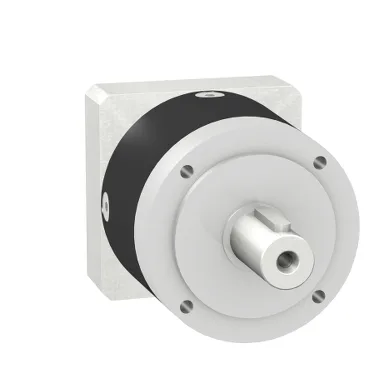
Planetary gearbox, 8:1 reduction, 120 N.m continuous — now obsolete
The GBX1200080701F is a Schneider Electric planetary gearbox with a 120 mm housing diameter and an 8:1 reduction ratio. It delivers 120 N.m continuous output torque at 100 rpm and 30 °C, with a peak capability of 192 N.m for intermittent loads. Schneider has classified this unit as obsolete.
120 N.m continuous, 192 N.m peak — torque ratings that govern the application
The continuous torque rating of 120 N.m at 100 rpm and 30 °C defines the sustained load the gearbox can carry over its 30,000-hour service life. The maximum output torque of 192 N.m at the same speed and temperature covers short-duration overloads — stay within the continuous figure for duty-cycle applications. Efficiency is listed at 94 %, which means about 6 % of input power is lost as heat through the straight-tooth mesh and bearing friction. For a 120 N.m output at 100 rpm (roughly 1.26 kW mechanical), the thermal loss is about 80 W — well within the black anodized aluminium housing's natural convection capacity at the rated ambient range of -25 to 90 °C. Torsional backlash is 8 arc-min maximum, and torsional rigidity is 12 N.m/arcmin. For positioning applications, the 8 arc-min of lost motion at reversal means the output shaft can rotate about 0.13° before the gear teeth re-engage — acceptable for many conveyor and indexing drives but not for precision servo axes.
Shaft loading limits and environmental protection
The output shaft accepts a maximum axial force of 2100 N and a maximum radial force of 1500 N, both at 100 rpm and measured at the mid-point of the shaft extension. These limits drop to 2800 N axial and 2000 N radial if the service life target is reduced to 10,000 hours — the bearing life scales with the cube of the load. Shaft output sealing is rated IP54, meaning the output seal resists dust ingress and splashing water but is not submersible. The gearbox is lubricated for life — no re-greasing interval to schedule. Shaft material is C45 medium-carbon steel, standard for this torque class. Noise level is 65 dB at 1 m under no-load conditions. The straight-tooth geometry is inherently noisier than helical gearing at higher speeds; expect a moderate increase under load due to tooth deflection.