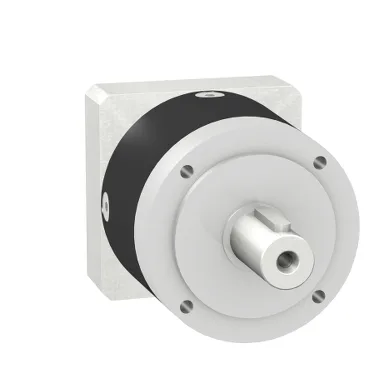
Is the GBX1200081081D still in production, and what does that mean for procurement?
The Schneider Electric GBX1200081081D carries a current lifecycle flag of Obsolete on the part record, with the product status field listing as current — the official line has been discontinued and the SKU no longer rolls off the factory line. For a pharmaceutical or process line running a Lexium servo coupled to this GBX-Ø 120 mm reducer, the procurement path is the independent surplus channel: traceable stock in sealed packaging, lot and date code confirmed per shipment against an RFQ, with no factory-direct reorder possible. No official successor or Schneider cross-reference appears in the record — the panel builder must either hold a verified surplus spare or plan a reducer swap that accepts the new GBX frame dimensions.
What the torque, backlash, and efficiency ratings mean in the panel
The gearbox delivers 120 N.m continuous output torque with a 192 N.m maximum peak — sized against the application's RMS load, not the peak, because excursions above continuous degrade the grease pack and shorten the 30000 h service life at 100 rpm, 30 °C. Maximum torsional backlash is 8 arc.min, so positioning repeatability sits in the lower-precision end of the planetary class — acceptable for conveyors, mixers, and indexing tables but not for high-precision registration or pick-and-place axes. Efficiency is 96 % for an 8:1 single-stage reducer, and torsional rigidity is 12 N.m/arcmin — the high efficiency reflects straight-cut gears rather than helical, which is also why noise level is 65 dB at 1 m no-load instead of the quieter helical figures.
Shaft loads, mounting, and the environment envelope
Maximum radial force Fr is 1500 N at 100 rpm over a 30000 h life at 30 °C, rising to 2000 N if the duty is capped at 10000 h at the same speed — the belt or pinion load has to be calculated against the curve, not the headline number. Maximum axial force Fa follows the same time-temperature trade-off: 2100 N over 30000 h at 30 °C, or 2800 N at 10000 h at 30 °C — relevant when a sprocket or coupling pushes along the shaft axis. The shaft output carries IP54 protection and the housing is black anodized aluminium with a C 45 shaft, lubricated for life; operating temperature spans -25…90 °C, and the unit can be mounted in any position.
What replaces it once the surplus runs out
For a line still on this reducer, the practical move is to confirm the count of service spares held and quote the volume needed against the RFQ — independent distribution can sometimes surface traceable lot stock that the OEM channel has long since closed.