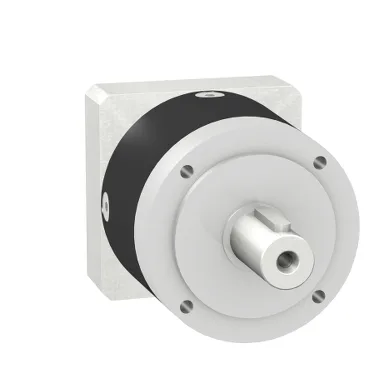
What 260 N.m continuous and 416 N.m peak mean for your drive train
The GBX1200120552F is a 120 mm-diameter planetary gearbox with a 12:1 reduction ratio. Its continuous output torque is 260 N.m at 100 rpm and 30 °C — this is the thermal steady-state limit for a 30,000-hour service life. The maximum output torque hits 416 N.m under the same conditions, which covers peak loads during acceleration or momentary overloads, but the duty cycle must stay within the continuous rating for the full service life. The 94 % efficiency means 6 % of the input power is lost as heat inside the housing. For a 260 N.m output at 100 rpm, that is roughly 160 W dissipated through the black anodized aluminium body — enough to feel warm but not hot in a ventilated enclosure. The straight teeth geometry contributes to this efficiency figure, though it produces a slightly higher noise signature than helical alternatives.
Backlash and torsional rigidity — the positioning accuracy trade-off
Maximum torsional backlash is 12 arc.min. That is a standard-precision planetary — fine for conveyor drives, indexing tables, or general motion where a few arc-minutes of lost motion at reversal is acceptable. For comparison, a precision-grade planetary in the same frame size typically offers 3–5 arc.min backlash but costs more and may have lower torque density. The torsional rigidity of 13 N.m/arcmin tells you how much the gear train winds up under load: at 260 N.m continuous, expect about 20 arc.min of elastic wind-up on top of the backlash. The axial force limit is 2100 N for the 30,000-hour life at 100 rpm, or 2800 N if you accept a 10,000-hour service life. Radial force is 1500 N for 30,000 hours, 2000 N for 10,000 hours — both measured at mid-span on the output shaft. These are the bearing limits; exceeding them shortens service life faster than torque overload does.
Obsolete — sourcing reality for the GBX1200120552F
The part is lubricated for life, so no field maintenance is needed beyond checking the shaft seal integrity. The IP54 rating on the shaft output means it resists dust ingress and splashing water — suitable for dry indoor environments but not washdown.
Noise and environmental fit for the application
Noise level is 65 dB at 1 m, no-load. That is about the level of a quiet office printer — noticeable but not loud. Under load the noise will rise a few dB due to gear mesh excitation. The straight teeth design means the gearbox is inherently noisier than a helical unit of the same ratio; if the application is in a sound-sensitive area (near operator stations, clean rooms), budget for an acoustic enclosure or consider a helical planetary alternative.