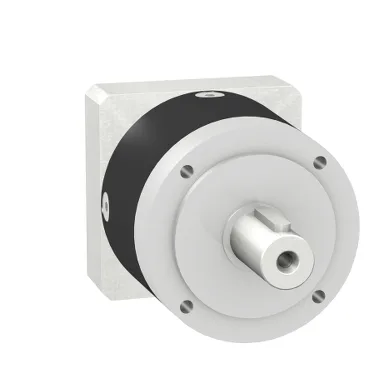
12:1 planetary reduction, 260 N.m continuous — what the ratings mean on the line
The GBX1200120554F is a Schneider Electric planetary gearbox with a 12:1 reduction ratio, straight-cut teeth, and a 120 mm housing diameter. It delivers 260 N.m continuous output torque at 100 rpm and 30 °C, with a maximum intermittent rating of 416 N.m under the same conditions. The 94 % efficiency figure means about 6 % of input power is lost to friction and windage inside the gearbox — typical for a single-stage planetary with straight teeth. That loss shows up as heat, so the 30,000-hour service life at rated load assumes the gearbox is mounted to a surface that can sink that heat. The 12 arc-min maximum torsional backlash is the total angular play across the gear train under no-load reversal. For positioning applications where the load reverses direction, that 12 arc-min of lost motion must be budgeted into the system accuracy — it is not a precision-grade backlash figure, but it is consistent with a commercial planetary gearbox in this torque class.
Sourcing an obsolete planetary gearbox — what to expect
Schneider Electric lists the GBX1200120554F as obsolete. For a BOM freeze or a line-down replacement, the key fit parameters to match are the 120 mm housing diameter, the 12:1 ratio, the shaft material (C 45 steel), and the output shaft loading limits — 2100 N axial and 1500 N radial at 100 rpm for the full 30,000-hour life.
Integration notes — mounting, loading, and environment
The black anodized aluminium housing measures 4.7 in (120 mm) in diameter. The shaft output carries an IP54 seal rating — that means it is protected against dust ingress and splashing water, but not against pressurized washdown or submersion. The gearbox is rated for ambient operation from -25 °C to 90 °C. The continuous torque rating of 260 N.m at 100 rpm and 30 °C is the design point for the 30,000-hour service life. If the application runs at higher speed, higher ambient temperature, or higher load, the service life drops accordingly — the 10,000-hour ratings for axial and radial forces are roughly 33 % higher than the 30,000-hour figures, which gives a rough derating curve. Noise level is specified at 65 dB at 1 m, no-load. That is the gear mesh noise from the straight-cut teeth under no-load conditions. Under load, expect the noise to rise a few dB as the tooth contact pattern changes. For noise-sensitive environments, a helical-gear planetary would run quieter, but at a higher cost and typically lower efficiency.