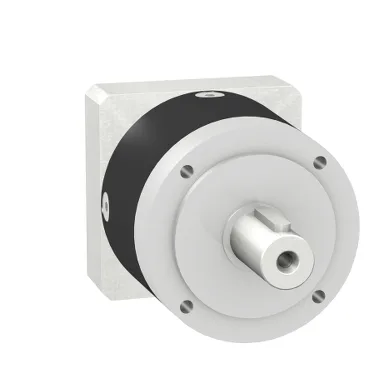
What the torque ratings mean for your drive train
The GBX1200121404F is a planetary gearbox with a 12:1 reduction ratio — it multiplies motor torque by roughly twelve while cutting output speed by the same factor. The continuous output torque is 260 N.m at 100 rpm, and that's the number you size the rest of the driven load around. Maximum output torque hits 416 N.m, but that's the short-term peak before the gear teeth or bearings yield — not a steady-state operating point. The straight-tooth (spur) planetary design gives you 94 % efficiency, meaning about 6 % of the input power turns into heat inside the housing. For a 1 kW motor, that's 60 W of heat to manage — the black anodized aluminium housing sheds it by natural convection in most panel-mount or machine-frame installations.
Lifecycle reality — this part is obsolete
Schneider Electric lists the GBX1200121404F as obsolete. If you have this on a BOM for a machine that's already in service, your sourcing path is through independent distribution — surplus, new-old-stock, or broker channels. The gearbox is lubricated for life, so there's no oil-change interval to track. Service life is rated at 30000 hours at 100 rpm and 30 °C ambient — that's about 3.4 years of continuous operation. If your duty cycle is intermittent or the load is below the continuous torque rating, the service life extends beyond that figure.
Mounting and load limits — what to check before you commit
The gearbox external diameter is 120 mm, and the shaft output seal is rated IP54 — that keeps dust and splash out of the bearing cavity, but it's not submersible. If the gearbox sits in a washdown zone, you'll need a secondary cover over the output shaft. Maximum axial force on the output shaft is 2100 N for the full 30000-hour service life, or 2800 N if you accept a shorter 10000-hour life. Radial force limits are 1500 N and 2000 N respectively, with the force applied at mid-span of the output shaft. Exceed these and the bearing life drops fast — the numbers assume the load is centered, not cantilevered. Torsional rigidity is 13 N.m per arcmin — that tells you how much the gear train winds up under load. For a positioning system, 12 arcmin of backlash plus the wind-up under 260 N.m means the output shaft can lag the input by roughly 32 arcmin total. That's fine for conveyor indexing or rotary table positioning; it's not a servo-grade precision reducer.
Acoustic and environmental envelope
Noise level is 65 dB measured at 1 meter, no-load. That's roughly the sound of a quiet office — noticeable but not ear-protection territory. Under load the noise rises a few dB as the gear teeth carry torque, but the straight-tooth geometry is inherently noisier than helical; if your application is in a sound-sensitive area, budget for an acoustic enclosure. The 90 °C ceiling is the internal grease limit — the housing can get hot from reflected motor heat or nearby equipment, so leave a 15-20 °C margin below that for reliability.