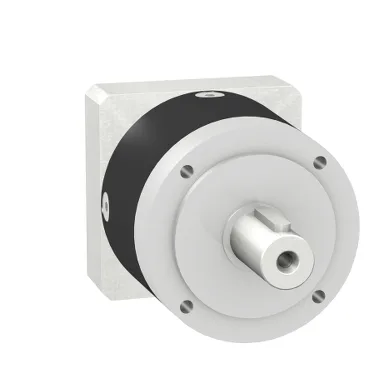
Obsolete — sourcing reality for this 15:1 planetary gearbox
The GBX1200150551F: For a line-down situation or a BOM freeze, this part is sourced through independent surplus channels — quantities are lot-specific and confirmed at RFQ.
Torque ratings that govern the load match
The continuous output torque is 230 N.m (2035.7 lbf.in) at 100 rpm and 30 °C — this is the rating that defines the steady-state load the gearbox can carry without exceeding its service life target. Maximum output torque reaches 368 N.m (3257.07 lbf.in) under the same conditions — this is the peak overload ceiling, not a continuous duty figure. Exceeding it risks tooth fracture or bearing failure. The 15:1 reduction ratio means the input speed is divided by 15 while torque is multiplied by roughly the same factor, minus the 94 % efficiency loss. That efficiency figure is the mechanical power throughput — 6 % is lost as heat in the gear mesh and bearings.
Mechanical limits and integration constraints
Maximum axial force Fa is 2100 N at 100 rpm for the 30000-hour service life, or 2800 N for a 10000-hour life. Maximum radial force Fr is 1500 N at 100 rpm for 30000 hours, or 2000 N for 10000 hours. These are the bearing and shaft load limits — overhung loads from pulleys or sprockets must be calculated against the radial figure. The gearbox external diameter is 120 mm (4.7 in), with a black anodized aluminium housing and a C 45 steel shaft. The shaft output carries an IP54 ingress protection rating — suitable for indoor environments with dust and splash exposure, but not washdown. Torsional rigidity is 13 N.m/arcmin, and maximum torsional backlash is 12 arc.min. The backlash figure matters for positioning accuracy in reversing or indexing applications — 12 arc.min is typical for a standard-precision planetary gearbox, not a zero-backlash unit. Service life is rated at 30000 hours at 100 rpm and 30 °C, and the gearbox is lubricated for life — no oil changes or regreasing intervals. Ambient temperature range for operation is -25 to 90 °C.
Noise and duty-cycle considerations
Noise level is 65 dB at 1 m, no-load — this is the acoustic signature without load. Under load, gear mesh noise typically increases by 3-8 dB depending on torque and speed. The straight teeth design is inherently noisier than helical gearing at higher speeds.