Obsolete — sourcing through independent channels
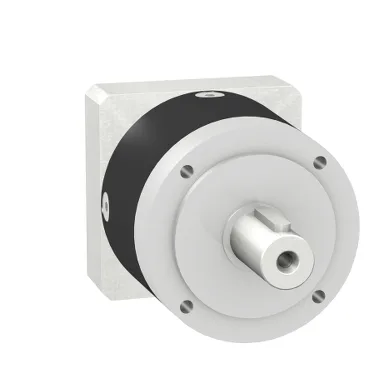
Schneider Electric has classified the GBX1200160553F as obsolete. This planetary gearbox is available through independent surplus and broker channels.
Torque capacity and reduction ratio
The 16:1 reduction ratio steps motor speed down while multiplying torque. Continuous output torque is 260 N.m at 100 rpm and 30 °C; maximum output torque reaches 416 N.m under the same conditions — this peak figure governs overload events like start-up or momentary jams. Torsional rigidity is 13 N.m/arcmin, meaning each 13 N.m of applied torque twists the output shaft by one arc-minute. For positioning applications, this stiffness combines with the 12 arc-min maximum backlash to define the total lost motion under load.
Service life and maintenance envelope
Rated service life is 30,000 hours at 100 rpm and 30 °C — roughly 3.4 years of continuous operation at that speed. The gearbox is lubricated for life, so no oil changes or regreasing intervals are scheduled within that window. Axial force (Fa) is limited to 2100 N for the full 30,000-hour life, or 2800 N for a 10,000-hour duty cycle. Radial force (Fr) is 1500 N for 30,000 hours, 2000 N for 10,000 hours, measured at mid-span on the output shaft. These limits protect the output bearings — exceeding them shortens service life.
Environmental and mechanical fit
The gearbox external diameter is 120 mm — this is the envelope the mounting bracket or flange must clear. Shaft output sealing is IP54, which keeps dust and splashing water out of the output seal area but does not protect the motor-side input. The housing is black anodized aluminium; the shaft is C45 medium-carbon steel. Noise level at 1 m, no-load, is 65 dB — comparable to a quiet office environment, not a machine shop floor.
Efficiency and thermal behaviour
Listed efficiency is 94 %. This means 6 % of the input power is lost as heat inside the gearbox. At 260 N.m continuous output torque and 100 rpm, the mechanical power is about 2.7 kW; the 6 % loss equals roughly 160 W of heat that must be dissipated through the aluminium housing to the surrounding air.