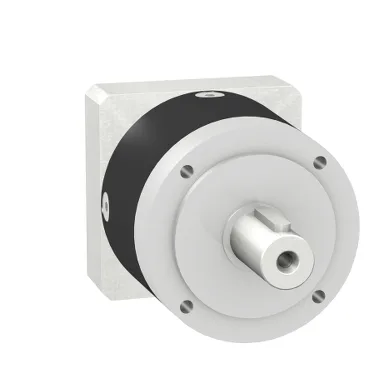
Obsolete — procurement path for this planetary gearbox
The GBX1200160702F: For a BOM line that requires this exact 16:1 planetary gearbox, the supply path is through independent distribution.
The 16:1 reduction with a continuous output torque of 260 N.m at 100 rpm and a maximum output torque of 416 N.m defines the load envelope. The continuous figure governs steady-state operation; the maximum covers transient peaks like acceleration or momentary overload. Torsional rigidity is 13 N.m/arcmin — this is the stiffness the gearbox presents to the load. For positioning applications, this value combined with the 12 arc.min maximum backlash determines the repeatable accuracy under varying load.
Service life and maintenance envelope
Rated service life is 30000 hours at 100 rpm and 30 °C, and the unit is lubricated for life — no scheduled re-greasing. The ambient temperature range spans -25 to 90 °C, so the gearbox can sit in a warm cabinet or a cold plant floor without derating the life figure, provided the load stays within the continuous torque limit. Maximum axial force (Fa) is 2100 N for the 30000-hour life, or 2800 N if the application accepts a 10000-hour service life. Radial force (Fr) limits are 1500 N and 2000 N respectively, applied at mid-distance from the output shaft. These set the overhung load capacity — relevant when a pulley, sprocket, or gear is mounted directly on the output.
Physical integration and protection
The gearbox has a 120 mm external diameter, black anodized aluminium housing, and a C45 steel output shaft. Straight teeth means the gear mesh is simpler and more cost-effective than helical, but generates higher noise — the listed 65 dB at 1 m, no-load is the acoustic baseline. Shaft output protection is IP54 — dust-protected and splash-resistant, but not submersible. In washdown or outdoor environments, the gearbox body itself may need additional shielding if the seal at the shaft exit is the only barrier. Efficiency is listed at 94 %. For a 260 N.m continuous output at 100 rpm, the input power is roughly 2.7 kW; the 6 % loss appears as heat, which must be dissipated through the aluminium housing and the mounting interface.