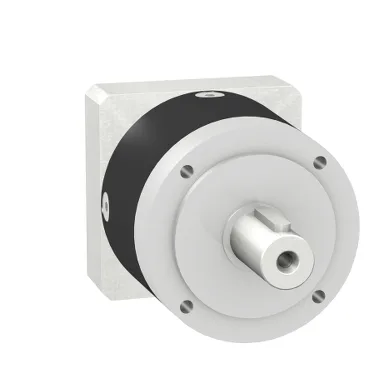
Where this gearbox drops in on a drive train
Schneider Electric GBX1200160844D is a planetary gearbox from the GBX series, sized to the 120 mm frame and built around a 16:1 single-stage reduction (cite:,cite:). It bolts to the back of a Lexium servo or stepper motor — the GBX short name is the matching footprint code for that motor family — so the upstream drive sizing drives the gearbox choice, not the other way around. The straight-tooth gear topology keeps the unit compact and relatively quiet for a planetary, and the housing is black anodized aluminium with the shaft turned from C 45 medium-carbon steel — both stock choices for a servo-adjacent reducer that lives on the machine frame rather than inside a gearbox pit (cite:,cite:,cite:).
Torque envelope and where it actually matters
The headline torque ratings are 260 N.m continuous output torque and 416 N.m maximum output torque — peak is roughly 1.6× continuous, which is the typical overload headroom the upstream servo controller expects to see during accel/decel cycles (cite:,cite:). Service life is rated at 30000 h at 100 rpm and 30 °C, which is the operating window that frames both the torque and the shaft-load numbers below it; go past any one of those three and the lifetime math needs to be redone (cite:).
Shaft loads — radial and axial, with two time bases
Maximum radial force Fr is 1500 N at 100 rpm, applied at mid-distance from the output shaft, over the 30000 h life — relax the duty to 10000 h and the rating climbs to 2000 N (cite:). Maximum axial force Fa is 2100 N at 100 rpm over 30000 h, rising to 2800 N over the shorter 10000 h envelope — the dual ratings let the buyer trade service life against peak shaft push without having to step up a frame size (cite:).
Efficiency, backlash, and what shows up on the line
Mechanical efficiency is listed at 94 %, which for a single-stage 16:1 planetary is right where it should be — meaning roughly 6 % of the input power walks off as heat into the housing and the surrounding structure (cite:). Maximum torsional backlash is 12 arc.min and torsional rigidity is 13 N.m/arcmin, so positioning repeatability stays well inside what a typical servo positioning loop can correct — backlash here is a sizing number, not a daily-tuning number (cite:,cite:). No-load noise is 65 dB at 1 m, which is unobtrusive next to the driven machine; it does not require an enclosure acoustic treatment on its own account (cite:). Moment of inertia is 1.75 g.cm², small enough that it does not load the servo loop at the accelerations the GBX frame is designed for — pair it with the motor's own rotor inertia and check the ratio per the drive manual (cite:).
Environment, sealing, and what it can sit in
Operating ambient is -25…90 °C and the shaft seal carries an IP54 rating — the gearbox tolerates a normal indoor machine environment, dust and the occasional splash, but it is not a sealed washdown unit (cite:,cite:). It is lubricated for life, so there is no route-side grease point to service — for a maintenance tech, the GBX is essentially a fit-and-forget reducer as long as the operating envelope above is respected (cite:). Mounting position is listed as any position, which simplifies retrofit work where the driven shaft dictates the gearbox orientation rather than the other way around (cite:).
Lifecycle and how to put it on the BOM
Product status is active, so the GBX1200160844D is a current Schneider Electric line item — not an EOL hunt, no last-time-buy window open (cite:).