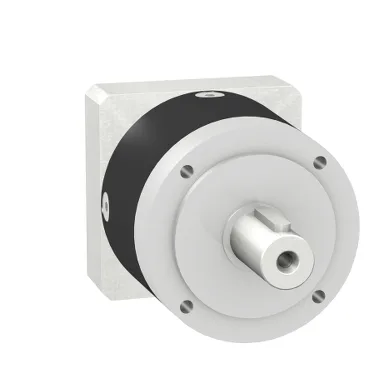
Where this reducer bolts onto the line
The GBX1200200843D is a 120 mm-frame planetary gearbox from the Schneider Electric GBX family, sized for servo-driven packaging, indexing, and rotary-table duty where a 20:1 reduction drops the motor into its best-efficiency window while multiplying torque into a downstream conveyor, screw, or pouch-maker main shaft. Mounting position is unrestricted, so the unit drops into a machine skid or overhead gantry without concern for oil-bath orientation — a real convenience when retrofitting an existing axis where the original gearbox had to stay upright. Ambient operating envelope spans -25...90 °C, covering the inside of an enclosure on a tropical line as well as an unheated north-aisle in winter, and the shaft seal is rated IP54 for splash resistance but not high-pressure washdown.
Torque and shaft load the bearing stack will carry
Continuous output torque is 260 N.m and maximum (peak) output torque is 416 N.m — the peak figure is what a sizing check should anchor on, because AGMA-style shock loading during a jam or quick-stop routinely pushes shaft work above the continuous rating. Maximum radial force Fr is 1500 N at 100 rpm over 30,000 hours or 2000 N at 100 rpm over 10,000 hours, with load applied at mid-distance from the output shaft; maximum axial force Fa is 2100 N at 100 rpm over 30,000 hours or 2800 N at 100 rpm over 10,000 hours. Service life is rated at 30,000 hours at 100 rpm and 30 °C, meaning the gearbox is lubricated for life — no grease-port schedule to track, which removes a maintenance-hand-off but also rules out re-lube as a mid-life rescue if the duty is hotter or faster than the rated envelope. The output shaft is C 45 carbon steel in a black anodized aluminium housing, giving the gearbox its 120 mm external diameter and the rigidity to handle the rated Fa/Fr loads without housing flex showing up as drift on a precision downstream coupling.
Precision, efficiency, and noise — what motion-control designers actually care about
Maximum torsional backlash is 12 arc.min and torsional rigidity is 13 N.m/arcmin, placing the unit in the mid-precision band — adequate for general automation but not for the sub-arcmin repeatability a pick-and-place vision stage would demand. Efficiency is 94 %, which is on the high side for a single-stage planetary and means a 20:1 reduction at the input will dissipate roughly 6 % of the input power as heat inside the housing — the thermal envelope in covers the resulting self-warmth, but a sealed enclosure should still account for it. Noise level is 65 dB at 1 m under no-load — a useful sanity figure when an operator station sits next to the gearbox, since loaded running typically adds several decibels and the 65 dB baseline lets a field tech judge bearing wear by ear against an original baseline. Moment of inertia at the input is 1.5 g.cm² — small enough that the gearbox adds negligible reflected inertia to a typical servo rotor, so high-acceleration profiles do not need re-tuning just to absorb this stage.