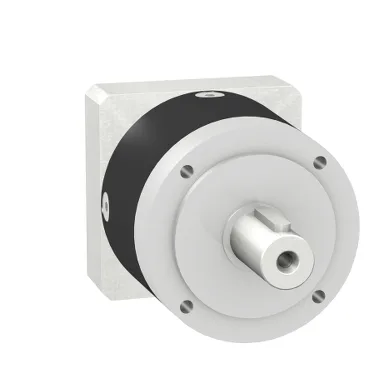
25:1 reduction, 230 N.m continuous — what it delivers
The GBX1200250551F is a planetary gearbox from Schneider Electric's GBX family, with a 25:1 reduction ratio and a continuous output torque of 230 N.m at 100 rpm (30 °C ambient). That torque rating is the figure to size against your driven load — the maximum output torque is 368 N.m under the same conditions, but continuous duty stays at 230 N.m. Efficiency is listed at 94 %, which means about 6 % of the input power is lost as heat. For a motor in the 1–2 kW range, that heat is manageable with natural convection through the black anodized aluminium housing. Noise level is 65 dB at 1 m, no-load — a straight-tooth planetary at this ratio is inherently noisier than a helical, so if the gearbox sits near an operator station, budget for an enclosure or acoustic treatment.
Load limits and service life — plan the duty cycle
Service life is 30,000 hours at 100 rpm and 30 °C ambient — that's about 3.4 years of continuous running. The gearbox is lubricated for life, so no oil changes are needed within that window. Maximum radial force on the output shaft is 1500 N at 100 rpm for the 30,000-hour life, or 2000 N if you accept a 10,000-hour life. Axial force limits are 2100 N and 2800 N respectively. These are the numbers to check if the load applies side or thrust loads — belt drives or overhung pinions need derating. Torsional backlash is 12 arc.min maximum — acceptable for general positioning but not for precision indexing without a separate encoder. Torsional rigidity is 13 N.m/arcmin, so the shaft twist under full torque is about 28 arc.min.
Obsolete — sourcing through independent channels
Schneider Electric lists the GBX1200250551F as obsolete. No official successor is recorded — the GBX series has been replaced by newer planetary families with different mounting dimensions and ratios. Quantities are confirmed at RFQ; no stock-holding claim is made here. The IP54 shaft output and straight-tooth design mean the replacement will likely be a different frame size — a board or bracket spin may be required.