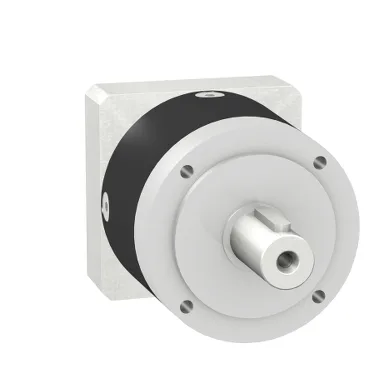
Torque and duty cycle — continuous vs peak
The GBX1200250703D: Continuous output torque is 230 N.m, with a maximum output torque of 368 N.m. That 60% headroom above continuous means the gearbox handles short overloads without damage, but sustained operation should stay at or below the 230 N.m figure. Service life is rated at 30,000 hours at 100 rpm and 30 °C. If your cycle runs faster or hotter, derate accordingly — the 30,000-hour figure drops at higher speeds or ambient temperatures above 30 °C.
Backlash and stiffness for positioning
Maximum torsional backlash is 12 arcmin — standard precision for a straight-tooth planetary. Torsional rigidity is 13 N.m/arcmin, so under a 130 N.m load the output shaft twists about 10 arcmin. For indexing or pick-and-place, factor this into the positioning budget. Straight teeth mean lower cost and higher efficiency (94 %) than helical, but with more audible noise — 65 dB at 1 m, no-load. That noise figure is measured without load; under torque it will rise.
Shaft loads and mounting flexibility
Maximum axial force Fa is 2100 N at 100 rpm for the full 30,000-hour life, or 2800 N if you accept a 10,000-hour service life. Radial force Fr at the mid-point of the output shaft is 1500 N for 30,000 hours, 2000 N for 10,000 hours. Overhung loads from pulleys or sprockets must stay within these curves. Mounting position is any orientation — the gearbox is lubricated for life, so no breather or oil-level check is needed. The shaft output seal is IP54, which handles dust and splash but not washdown.