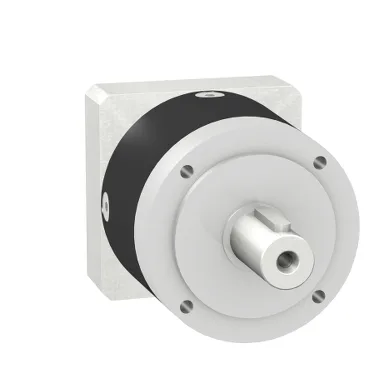
32:1 planetary — 260 N.m continuous, 416 N.m peak
The GBX1200320554F is a straight-tooth planetary gearbox from Schneider Electric's GBX series, with a 120 mm housing diameter and a 32:1 reduction ratio. The continuous output torque is 260 N.m at 100 rpm, with a maximum peak of 416 N.m at the same speed — the margin covers transient overloads like start-up inertia or momentary jams. Efficiency is 94 %, which means about 6 % of the input power is lost as heat inside the gearbox. For a motor delivering 2.2 kW at the input, that's roughly 130 W of thermal dissipation — the black anodized aluminium housing sinks that to the ambient air, but in a confined enclosure you'll want to check the temperature rise against the -25 to 90 °C operating range.
Load ratings and bearing capacity
The service life is 30,000 hours at 100 rpm and 30 °C — that's the L10 life under rated continuous torque. If the application runs 24/7, that's about 3.4 years before the first bearing or gear wear becomes statistically likely. The gearbox is lubricated for life, so there's no regrease interval to schedule. Axial force on the output shaft is limited to 2100 N for the full 30,000-hour life, or 2800 N if you accept a shorter 10,000-hour life. Radial force (overhung load applied at mid-shaft) is 1500 N for 30,000 hours, 2000 N for 10,000 hours. These numbers govern the belt-drive or chain-sprocket load you can hang off the output without overloading the bearings. Torsional rigidity is 13 N.m per arcminute of wind-up — that's the stiffness the gearbox presents to the load. Combined with the 12 arcmin maximum backlash, the total lost motion under load is the sum of the backlash plus the wind-up from the applied torque. For a positioning axis that needs repeatability under 0.5°, this gearbox will deliver; for sub-arcminute indexing, you'd need a lower-backlash unit.
Obsolete — sourcing through surplus channels
Schneider Electric has marked the GBX1200320554F as obsolete. The part is available through independent surplus and broker channels — quantities are lot-specific and confirmed at RFQ. No pin-compatible or dimensionally identical drop-in replacement is listed by Schneider, so a substitution would require verifying the mounting envelope and shaft interface.