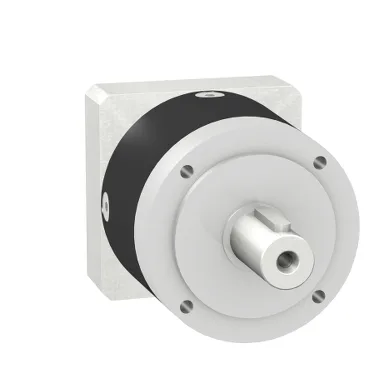
Torque and backlash — what the numbers mean for a motion axis
The GBX1200321401F delivers 260 N.m continuous output torque at 100 rpm and 30 °C, with a maximum of 416 N.m at the same speed and temperature — the ceiling for short-duration peak loads before the gear train exceeds its design margin. Torsional rigidity is 13 N.m/arcmin — the stiffness of the gear train under load. At the continuous torque of 260 N.m, the wind-up is roughly 20 arcmin (260 / 13), which the controller must account for in the servo tuning or the position loop.
Lifecycle status — obsolete, sourced through independent channels
Available through independent surplus and broker channels. Quantities are lot-specific and confirmed at RFQ; no stock-holding claim is made here.
Mechanical ratings that govern the installation
Rated service life is 30,000 hours at 100 rpm and 30 °C — this is the L10 life under continuous rated torque. The gearbox is lubricated for life, so no maintenance oil changes are needed within that window. Maximum axial force on the output shaft is 2100 N for the 30,000-hour life target, or 2800 N if the application accepts a 10,000-hour service life. Maximum radial force applied at mid-distance on the output shaft is 1500 N for 30,000 hours, 2000 N for 10,000 hours. Exceeding these shortens bearing life below the rated hours. Shaft output IP54 — the seal at the output shaft keeps out dust and splashing water, but the gearbox body is not submersible. Ambient operating range is -25 to 90 °C.
Efficiency and noise — the operating signature
Efficiency is 94 % — the power loss through the gear train is 6 %, which dissipates as heat. For a 260 N.m continuous output at 100 rpm (roughly 2.7 kW mechanical), the heat loss is about 160 W. The black anodised aluminium housing sheds this through natural convection; forced cooling is not required at the rated duty. Noise level is 65 dB at 1 m, no-load — this is the acoustic signature of the straight-tooth planetary stage under no external torque. Under load the noise rises slightly as the tooth contact force increases, but the 65 dB figure gives a baseline for enclosure sound-proofing estimates.