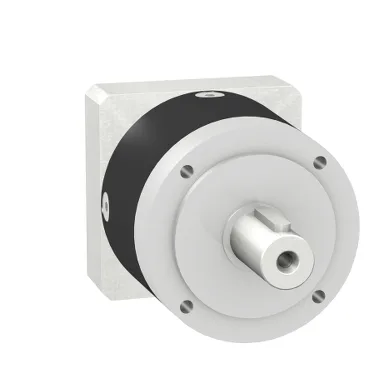
Planetary gearbox, 40:1 — what the torque ratings mean for a drive train
The GBX1200400552F is a straight-tooth planetary gearbox in a 120 mm diameter housing, delivering a 40:1 reduction. The continuous output torque is 230 N.m at 100 rpm, with a maximum intermittent torque of 368 N.m at the same speed — the 60 % headroom covers acceleration peaks and momentary overloads without exceeding the 30,000-hour service life at rated conditions. Efficiency is listed at 94 %, which means roughly 6 % of the input power dissipates as heat inside the housing. For a 230 N.m output at 100 rpm (about 2.4 kW mechanical), the thermal loss is around 150 W — the black anodized aluminium housing sinks that without forced cooling in most ambient conditions up to 90 °C.
Sourcing an obsolete planetary gearbox — lifecycle and supply reality
No pin-compatible direct substitute is documented in the Schneider GBX family.
Mechanical constraints — shaft loads, backlash, and service life
The output shaft carries a maximum radial force of 1500 N at 100 rpm for the full 30,000-hour life, or 2000 N if the application accepts a 10,000-hour replacement interval. Axial force limits are 2100 N and 2800 N respectively under the same duty cycles. Overhung loads from pulleys or sprockets must stay within these bounds to avoid bearing fatigue. Torsional rigidity is 13 N.m/arcmin — for a 230 N.m continuous load, the elastic wind-up under load is about 18 arcmin before the 12 arcmin backlash is taken up. This matters for positioning accuracy in indexing or servo-driven axes where cumulative angular error affects registration.