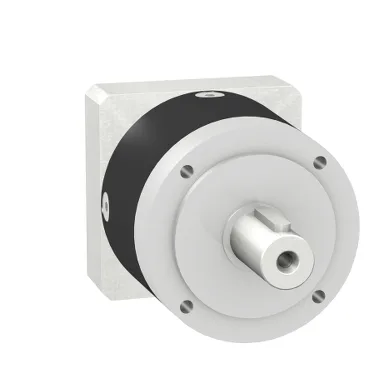
What the 40:1 reduction and 230 N.m continuous torque mean for your application
The GBX1200400553F is a Schneider Electric planetary gearbox with a 40:1 reduction ratio and a continuous output torque of 230 N.m at 100 rpm, rated for a service life of 30,000 hours under those conditions. Planetary design with straight teeth means it's built for high torque density in a compact footprint — the 120 mm diameter housing keeps the envelope tight, but the straight-cut teeth will be noisier than helical at the same load. The 94% efficiency figure tells you how much of the input power reaches the output shaft — expect about 6% loss as heat, which the black anodized aluminium housing dissipates across the -25 to 90 °C operating range.
Load capacity and mechanical limits you need to respect
Maximum output torque hits 368 N.m at 100 rpm, but that's the peak — the continuous rating of 230 N.m is the number you design your duty cycle around to hit the 30,000-hour service life. Maximum radial force Fr is 1500 N at 100 rpm for the 30,000-hour target, applied at mid-distance from the output shaft; you can push to 2000 N if you accept a 10,000-hour life. Maximum axial force Fa is 2100 N at 100 rpm for the full life rating, or 2800 N for a shorter 10,000-hour window — the C 45 steel shaft handles the thrust, but the bearing stack is the limiter here. Torsional rigidity is 13 N.m/arcmin — that's the stiffness of the gear train under load; for positioning applications, the 12 arc-min maximum torsional backlash means the output shaft has about 0.2° of slop before the input reverses direction.
Lifecycle reality — this one is obsolete
The gearbox is lubricated for life and sealed at the shaft output to IP54, so there's no maintenance access — it's a fit-and-forget component until the 30,000-hour life is up.