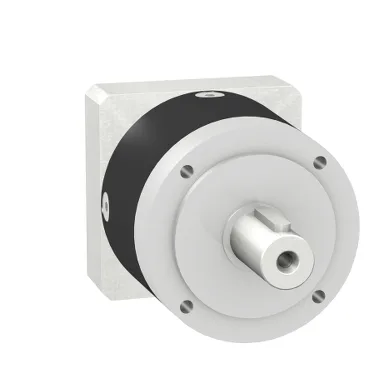
Planetary gearbox for precision indexing and positioning
The GBX1200600553F is a planetary gearbox from Schneider Electric's GBX series, designed for applications that need a compact, high-ratio speed reduction with low backlash. It's a straight-teeth planetary, 120 mm diameter, with a 60:1 reduction ratio — that's a lot of torque multiplication in a single stage, so it's a fit for indexing tables, rotary actuators, or conveyor drives where you need to hold position under load. Rated for 260 N.m continuous output torque at 100 rpm and 30 °C, with a maximum of 416 N.m for intermittent peak loads. The 94 % efficiency means you're not losing much to heat — important when you're sizing a motor and need to account for the gear train's losses.
Backlash and rigidity — what the numbers mean for your axis
Maximum torsional backlash is 14 arc.min. That's the angular play between input and output when you reverse direction — for a positioning axis, this tells you the repeatability floor. If your application needs better than 14 arc.min, you'd look at a low-backlash or preloaded planetary; for general indexing or conveyor positioning, this is typical for a straight-tooth planetary. Torsional rigidity is 12 N.m/arcmin — that's the stiffness of the gear train. It means that under a 12 N.m load, the output shaft will twist by 1 arcminute. For servo applications, this stiffness affects the system's resonant frequency; a stiffer gearbox lets you tune the servo loop tighter without hitting mechanical resonance. The gearbox is rated for 30,000 hours service life at 100 rpm and 30 °C, and it's lubricated for life — no oil changes, no maintenance schedule for the gearbox itself. That's a solid life for a production line running three shifts; at lower duty cycles it'll last longer.
Load ratings — axial and radial forces at the output shaft
Maximum axial force (Fa) is 2100 N for the full 30,000-hour life at 100 rpm, or 2800 N if you accept a shorter 10,000-hour life. That's the thrust load the output bearing can handle — think of a vertical screw jack or a belt drive with tension pulling along the shaft axis. Maximum radial force (Fr) is 1500 N for 30,000 hours, or 2000 N for 10,000 hours, with the force applied at mid-distance from the output shaft. That's the side load from a belt or chain drive. If your sprocket or pulley is mounted further out on the shaft, the effective radial load capacity drops — you'd need to calculate the moment arm. Both force ratings are at 100 rpm and 30 °C. Run it faster and the bearing life shortens; run it hotter and the grease life drops. The IP54 shaft output seal keeps dust and splash out, but it's not submersible — fine for a dry factory floor, not for washdown.
Sourcing reality — obsolete but available
It's available through independent surplus and broker channels. Quantities are lot-specific — we can quote against your BOM line and confirm availability at RFQ time.