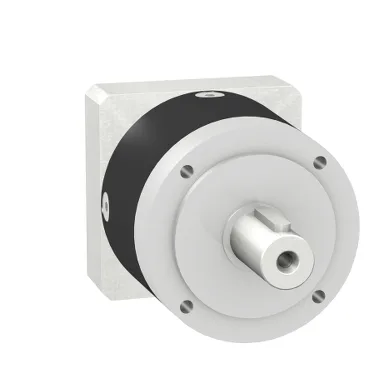
The GBX1200800554F is a straight-tooth planetary gearbox with an 80:1 reduction ratio, sized for a 120 mm output stage. That ratio means the input speed is divided by 80 — a 3000 rpm servo motor delivers 37.5 rpm at the output, with the torque multiplied correspondingly. Continuous output torque is 260 N.m at 100 rpm, with a maximum intermittent rating of 416 N.m at the same speed. The 260 N.m figure is the thermal limit for sustained duty — the gearbox will run indefinitely at that load within the 30 °C ambient, 30000-hour service life envelope. Efficiency is listed at 94 %, which is respectable for a straight-tooth planetary. The 6 % loss is mostly gear mesh friction and bearing drag; at 260 N.m output, that's about 16 N.m of input torque lost as heat, so the housing needs free air movement to stay within the -25 to 90 °C operating range.
Sourcing reality — obsolete, quoted to order
Schneider Electric lists this gearbox as obsolete. Available through independent distribution channels — quantities are confirmed at RFQ, and the price reflects the surplus/broker market. The lubricated-for-life design means no field greasing schedule, but the 30000-hour service life at rated load is the replacement trigger; plan a changeout at that interval. Before committing the BOM line, confirm the shaft interface: C 45 steel output shaft, IP54 at the shaft exit, maximum axial force 2100 N and radial force 1500 N at 100 rpm for the full 30000-hour life. The 14 arc-min maximum torsional backlash is typical for a standard-precision planetary — if your application needs tighter positioning, this gearbox may not hold the repeatability.
Integration notes for the panel builder
Black anodized aluminium housing, 120 mm outer diameter. The straight-tooth design is noisier than a helical planetary — expect 65 dB at 1 m no-load, which may require acoustic enclosures in quiet environments. Torsional rigidity is 12 N.m/arcmin — that's the stiffness the gear train presents to the load. For a servo axis with rapid direction changes, this figure determines how much wind-up the controller must compensate for in the gain loop.