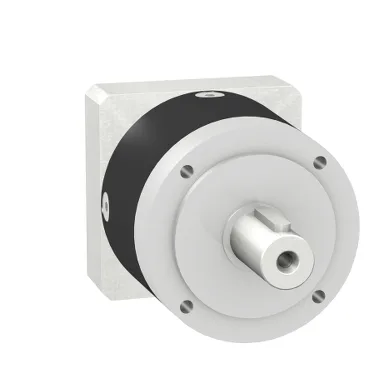
Discontinued GBX — what fills the BOM line now
The GBX1600031382D is a Schneider Electric planetary gearbox from the GBX family in the 160 mm frame, carrying a 3:1 reduction ratio and a continuous output torque of 400 N.m with a 640 N.m peak — the standard planetary reducer pairing for a servo axis on packaging, converting, or material-handling machinery. The part sits in the Schneider catalogue as obsolete, and lifecycle records show no official successor or pin-compatible second source on the same frame — this is a phase-out situation, not a running production line, so procurement should treat each RFQ as a discrete sourcing event rather than a replenishment cycle.
Torque, life and the duty window
The 30,000 h service life figure is anchored to a 100 rpm continuous output at 30 °C ambient — peak loads up to 640 N.m are transient capacity, not the sustained duty point. Above 100 rpm or above 30 °C the 30,000 h hour-meter shrinks roughly in proportion to the thermal and mechanical loading curve on the gearbox drawing, so the headline life number is a steady-state ceiling, not a guaranteed floor across the full operating envelope. Axial and radial shaft loads are bounded by 6,000 N axial and 4,200 N radial at 100 rpm over the full 30,000 h service life, rising to 8,000 N axial and 6,000 N radial if the application will only run 10,000 h — a useful trade when the driven element (a heavy pulley or pinion) sits well outside mid-shaft and the design wants the bearing reaction absorbed by the gearbox case rather than the driven shaft.
Precision signature and acoustic footprint
Torsional rigidity is 38 N.m/arcmin with a maximum backlash of 6 arc.min and a 12.14 g.cm² moment of inertia at the input — the right ballpark for a positioning axis on a servo-driven conveyor or labelling head, but not a precision gearbox by CNC-tooling standards; if the application demands sub-arc-min repeatability on a high-ratio reduction, a GBX variant with the helical option is the more honest fit. Efficiency is listed at 96 % and the no-load noise figure is 70 dB at 1 m — straight-cut gearing is the source of both the higher efficiency (no helical sliding loss) and the audible signature, so acoustically sensitive installations (medical assembly, clean-room-adjacent cells) should plan for an enclosure or a distance cushion rather than expecting a quiet gearbox by construction.
Mechanical envelope and field mounting
The 160 mm gearbox external diameter mates with the GBX family servo-adapter footprint, the IP54 shaft seal keeps out splashing coolant and washdown mist (not sustained jetting), and the housing is black anodized aluminium with a C 45 shaft — lightweight enough that the reducer typically mounts to the motor flange rather than to the machine frame, with the driven load hung off the output shaft. Operating ambient runs -25 to 90 °C, mounting position is unrestricted, and the unit is lubricated for life — no oil ports to plumb on the field service route, which matters when a line-side swap needs to be a one-visit repair instead of a scheduled gearbox drain and refill.
Sourcing the obsolete line
Schneider has retired the GBX1600031382D, so the BOM line is fed from independent distribution rather than the factory-direct channel — independent stocking is lot-dependent and each RFQ returns a real answer on quantity and condition, not a standing supply contract. The procurement question on an obsolete reducer like this is usually not price-per-unit but whether the supplier holds a traceable, unused surplus unit or a working pull from a decommissioned line — the 30,000 h service-life figure is a duty assumption, not a clock that started when the part shipped, so the buying decision is really about chain-of-custody and the hour-meter on the driven machine it came out of.