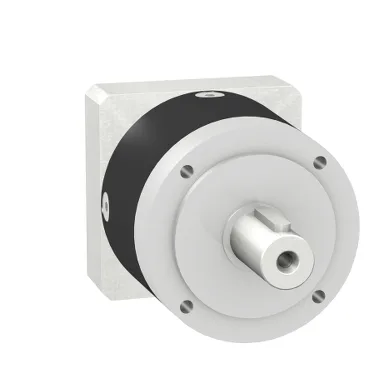
The GBX1600051401F is a straight-tooth planetary gearbox in a 160 mm diameter housing, delivering a 5:1 reduction ratio. The continuous output torque is 450 N.m at 100 rpm and 30 °C, with a peak capability of 720 N.m under the same conditions — the margin between continuous and maximum tells you the overload headroom for short-duration peak loads on a servo or stepper axis. Efficiency is listed at 94 %, which is typical for a single-stage planetary at this ratio — the 6 % loss shows up as heat in the housing, so the black anodized aluminium body (160 mm OD) acts as the primary heat sink. The shaft output carries an IP54 rating, meaning it resists dust ingress and splashing water but is not submersible — plan for a drip shield or boot if the axis sees washdown.
Load capacity and service life — axial, radial, and thermal limits
Maximum axial force Fa is 6000 N at 100 rpm for the full 30000-hour service life, or 8000 N if you accept a 10000-hour life. Radial force Fr follows the same pattern: 4200 N for 30000 hours, 6000 N for 10000 hours — both measured with the force applied at mid-distance from the output shaft. These are the numbers to check against your overhung load or thrust bearing budget. Torsional rigidity is 38 N.m/arcmin, and maximum torsional backlash is 6 arc.min — the rigidity figure governs windup under load in a positioning loop, while the backlash number sets the repeatability floor for reversing applications. The gearbox is lubricated for life, so no maintenance schedule for oil changes, but the operating ambient range is -25 to 90 °C — outside that, the grease viscosity breaks down.
Obsolete — sourcing through independent channels
Schneider Electric lists the GBX1600051401F as obsolete. The part is available through independent surplus and broker channels; quantities are lot-specific and confirmed at RFQ. If you are holding a BOM line that calls out this exact frame size and ratio, the 160 mm diameter and 5:1 reduction are the binding constraints — any replacement will need to match those mechanical interfaces first.