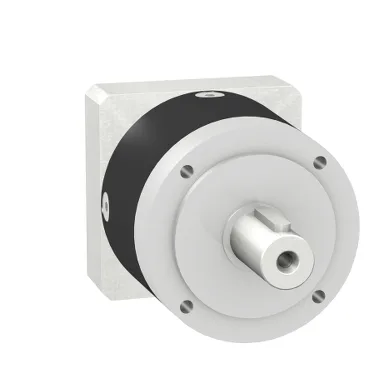
Torque ratings and what they mean for fit
The GBX1600081002F: Continuous output torque is 450 N.m at 100 rpm and 30 °C — this is the sustained load the gearbox carries without exceeding its 30,000-hour service life. Maximum output torque hits 720 N.m at the same speed and temperature, but that's the short-term peak for acceleration or shock loads, not a steady-state figure. The 8:1 reduction ratio means the input speed is eight times the output speed; torque multiplies by roughly the same factor minus the 94 % efficiency loss. That efficiency figure is the mechanical loss through the straight-tooth planetary stages — expect 6 % of input power to dissipate as heat through the black anodized aluminium housing.
Lifecycle reality — obsolete, sourced on request
Schneider Electric lists this GBX1600081002F as obsolete. Sourcing runs through independent surplus channels — quantities are lot-specific and confirmed at RFQ, not held as shelf stock. For a line-down replacement, the 160 mm diameter and 8:1 ratio are the binding constraints on fit. The IP54 shaft output rating means the output seal keeps out dust and splashing water — fine for most industrial environments but not washdown duty.
Backlash and load ratings that govern the application
Maximum torsional backlash is 6 arcmin — this is the angular play between input and output when the direction reverses. For positioning applications like indexing tables or pick-and-place, that 6 arcmin at the output translates to roughly 0.1 mm of linear error at a 100 mm radius; for continuous conveyor drives it's irrelevant. Maximum axial force Fa is 6000 N at 100 rpm for the full 30,000-hour life, or 8000 N if you accept a shorter 10,000-hour service window. Radial force Fr follows the same pattern: 4200 N for 30,000 hours, 6000 N for 10,000 hours — both measured at mid-distance on the output shaft. These are the limits for overhung loads like belt pulleys or chain sprockets mounted directly on the shaft.