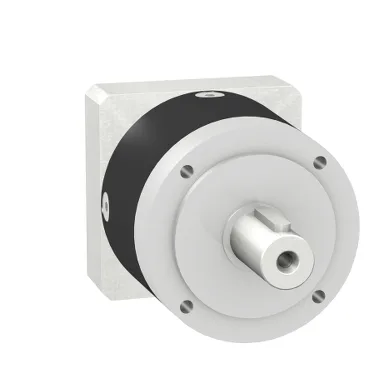
GBX planetary reducer at 160 mm frame with 9:1 stage
The GBX1600091383D is a Schneider Electric planetary gearbox built on the GBX 160 mm platform, with a single-stage 9:1 reduction and straight-cut teeth — the compact alternative to a helical or worm unit where radial stiffness matters more than quietness. The 160 mm gearbox external diameter defines the bolt circle and the output flange interface for the mating servo or stepper adapter. It is classified obsolete on the manufacturer's product record, so the OEM channel is no longer the source — the part is fulfilled through independent surplus stock quoted against an RFQ, with lot-specific availability and date codes confirmed at quote time.
Efficiency, backlash, torsional stiffness — what the numbers actually govern
Listed mechanical efficiency is 94 %, which for a single-stage planetary is the expected mid-band figure and means roughly 6 % of input power leaves as heat — at continuous duty that heat has to leave through the housing and the mounting flange, not just radiate from the case. The maximum torsional backlash is 10 arc.min and torsional rigidity is 41 N.m/arcmin: backlash sets the positioning repeatability you can expect on a servo-driven axis, while rigidity governs how much the output twists under peak torque before the position error shows up at the load.
Shaft loading envelope at 30 °C
Maximum radial load Fr is 4200 N at 100 rpm over a 30000 h life at 30 °C, rising to 6000 N if the design life is held to 10000 h at the same speed and temperature; maximum axial load Fa follows the same shape at 6000 N for the 30000 h case and 8000 N for the 10000 h case. Both figures are quoted with the radial force applied at mid-distance from the output shaft — moving the load point outward derates these numbers further on the same curve. The service life figure of 30000 h at 100 rpm at 30 °C is the bearing-fatigue reference; real-world life shortens with higher speed, higher ambient, and any side load that pushes Fr beyond the published envelope. The gearbox is lubricated for life, so the oil-change interval is not a maintenance event — replacement at end-of-life is the service model.