Torque envelope and duty cycle — 800 Nm continuous, 1280 Nm peak
The GBX1600121385D delivers 800 Nm continuous output torque, with a maximum peak of 1280 Nm — the 60% headroom above continuous covers acceleration transients and occasional overloads without exceeding the gear train's fatigue limit. At 100 rpm and 30 °C ambient, the rated service life is 30,000 hours; the axial and radial force capacities at that duty point are 6000 N and 4200 N respectively, both measured at mid-span on the output shaft. For higher load cycles, the gearbox can sustain 8000 N axial and 6000 N radial for 10,000 hours at 100 rpm — a useful derating curve for applications with intermittent peak forces.
Mechanical interface and integration constraints
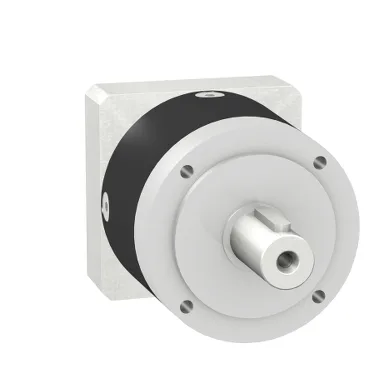
The 160 mm housing diameter and black anodized aluminium body with C45 steel shaft define the mounting envelope; the gearbox accepts any mounting position, simplifying layout in confined machine frames. Torsional rigidity is 41 N.m/arcmin — this stiffness figure governs the positioning error under load for servo-driven axes; the 10 arcmin maximum backlash is the total angular play across the gear train, measured at the output shaft. Shaft output sealing is IP54, adequate for dry indoor environments but not washdown; the gearbox is lubricated for life, eliminating maintenance intervals for oil changes.
Lifecycle status — obsolete, sourced through independent channels
Available through independent surplus and broker channels; quantities are lot-specific and confirmed at RFQ. For audit purposes, the part carries full manufacturer traceability through the supply chain.
Efficiency and noise — 94 % at 70 dB
The 94 % efficiency figure applies across the rated torque range — the straight-tooth planetary design achieves this with a noise floor of 70 dB at 1 m under no-load conditions, which is within typical machine shop ambient levels. Moment of inertia at the input is 12.37 g.cm², a parameter for servo loop tuning when the gearbox is paired with a motor; the 12:1 reduction ratio multiplies reflected inertia by the square of the ratio.