Obsolete on the Schneider line — what that does to the BOM line
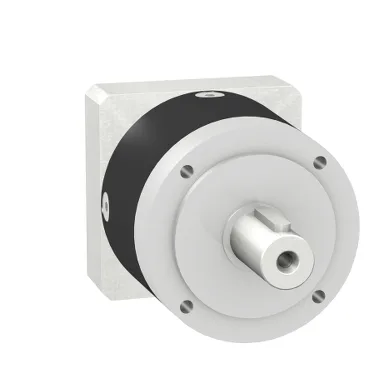
The GBX1600151384D sits in Schneider's GBX family as a 160 mm planetary gearbox with straight-cut gearing, and the productStatus field carries it as obsolete rather than active — a buyer walking in with this code is filling a hole, not booking a new build. Schneider's documentation pegs the headline torque at 700 N.m continuous output and 1120 N.m maximum, with a 15:1 reduction ratio — the gearhead is sized for the working duty first, the peak number second, so a retrofit has to be matched against the continuous figure rather than the headline maximum.
Efficiency, noise, and what they say about the drivetrain
Listed efficiency is 94 %, which on a planetary stage is the figure you budget against motor heat — the gearbox itself burns roughly 6 % of input power at rated load, and that loss shows up as case temperature, not useful work at the shaft. Noise is rated 70 dB at 1 m no-load, which is a typical straight-cut planetary reading and tells you the gearing will sing under load — it isn't a helical or low-noise selection, so cabinet placement and acoustic treatment matter more than for a quiet-duty reducer.
Shaft loading and the life envelope
Maximum radial force is 4200 N at 100 rpm over 30000 h at 30 °C, and maximum axial force is 6000 N over the same envelope — when a coupling or pinion is being specced to this output shaft, the 10000 h figures (6000 N radial / 8000 N axial) define the harder service envelope, and the 30000 h figures define the conservative design point. Service life is stated at 30000 h at 100 rpm and 30 °C, with the unit lubricated for life — the duty limit is thermal and load, not relube interval, so the surrounding cabinet airflow and the actual radial load on the shaft decide whether a buyer hits that 30000 h figure or burns through it early.
Backlash, rigidity, and what the precision spec buys
Maximum torsional backlash is 10 arc.min and torsional rigidity is 41 N.m/arcmin, putting this in the standard backlash class rather than a low-backlash selection — for an indexing or registration drive the buyer has to budget the lost motion, for a conveyor or mixer drive it is invisible. Moment of inertia at the input is 12.35 g·cm², a small reflected load that keeps the gearbox friendly to a servo drive's tuning loop — pairing a high-inertia load on a small servo is where this becomes a non-issue, and pairing it with a stepper or a high-acceleration cycle is where it would matter.
Form factor, sealing, and where it physically lives
The housing is black anodized aluminium at 160 mm gearbox external diameter with a C45 shaft, and mounting position is listed as any position — the lube is rated for the full envelope so vertical and inverted mounting do not change the service interval. Shaft output sealing is IP54, and the operating ambient is -25 to 90 °C — IP54 keeps out splashing water and dust but is not a washdown rating, so for food-grade, outdoor, or wet-duty cells this lands inside an enclosure rather than exposed to the line.