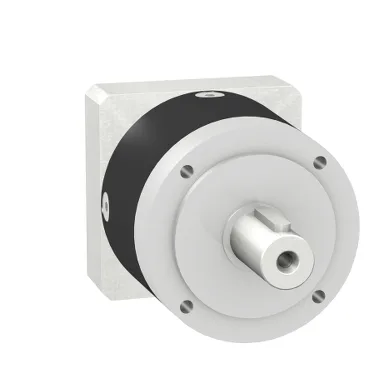
What GBX1600161082D actually is
The GBX1600161082D is a Schneider Electric planetary gearbox from the GBX family, with a 160 mm gearbox external diameter and a straight-tooth gear set, sized to bolt onto a servo or stepper drive of the matching GBX compatibility code and deliver a 16:1 reduction to the output shaft. It is sold under the short name GBX with a black anodized aluminium housing, a C 45 steel output shaft, and a lubrication-for-life fill — meaning the gearbox is sealed at the factory and the buyer does not schedule a grease interval for the internal planet stage.
Torque, backlash, and the load envelope
Continuous output torque is 800 N.m and maximum output torque is 1280 N.m, both governed by a 30,000-hour service life rating at 100 rpm and 30 °C; the 41 N.m/arcmin torsional rigidity and 10 arc.min maximum torsional backlash are the two numbers a positioning application will actually feel through the geartrain. The moment of inertia at the input is 7.47 g·cm², which sets the acceleration demand on the upstream servo — pair it with a motor whose rotor inertia lands within roughly an order of magnitude to keep the coupling stable under cyclic moves. Maximum radial force at the output shaft is 4200 N applied at mid-distance from the shaft during the 30,000-hour envelope, and 6000 N during a shortened 10,000-hour envelope; maximum axial force is 6000 N over the same 30,000-hour rating, climbing to 8000 N over 10,000 hours at 100 rpm and 30 °C — these are the bearing-life figures, not the gearbox mechanical stops.
Ambient envelope, sealing, and the noise floor
Operating ambient temperature spans −25 °C to 90 °C and the gearbox mounts in any position, so it drops into a vertical machine frame or an inverted actuator mount without remounting the planet carrier. The shaft output is sealed to IP54, which keeps splashing water and dust out of the output seal but does not make it a washdown housing — keep the gearbox out of direct jet wash and away from food-grade hose-down zones. Efficiency is 94% and the no-load noise level is 70 dB measured at 1 m — both consistent with a straight-tooth planetary stage; a helical stage would shift the noise floor lower and the efficiency figure slightly higher.