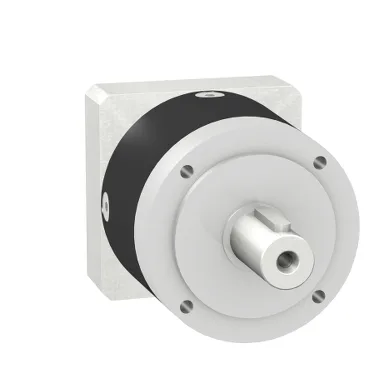
Where the 800 N·m continuous torque lands on a driven shaft
The GBX1600201082D is a planetary gearbox in Schneider's GBX series — a straight-cut, in-line reducer with a 20:1 reduction ratio, mounted in any position, and shipped lubricated for life so the unit drops into a drivetrain without a scheduled grease interval on the maintenance route. It carries 800 N·m continuous output torque and 1280 N·m peak at the output, with 41 N·m/arcmin torsional rigidity — the rigidity figure is the one that controls position-holding under a reversing load, while the peak figure is what trips a drive's torque limit before gearbox damage, so the drive should be clamped just inside 1280 N·m to use the gearbox's reserve without abusing it.
Service life, radial load, and the 30,000-hour envelope
The rated service life is 30,000 hours at 100 rpm and 30 °C ambient — and that figure is the headline number to take into a critical-spare decision rather than the peak torque, because a gearbox that runs to its hour rating quietly disappears from the line just when the matching servo motor is being held in stock. Maximum radial load Fr on the output shaft is 4200 N at mid-distance from the shaft face over that 30,000-hour envelope, rising to 6000 N if the duty is held to 10,000 hours — overhung loads from a coupling, sprocket, or pinion must be checked against the right curve, because the higher 10,000-hour figure is not a free upgrade if the asset is expected to run for the full 30,000 hours. Maximum axial force Fa is 6000 N over 30,000 hours at 100 rpm, 30 °C, and 8000 N if the same shorter-hour duty is accepted — the axial rating is what governs thrust loads from a vertical screw or a belt tensioner pulling along the shaft axis, and it should be checked even when the radial figure looks comfortable.
Sealing, inertia, and the thermal envelope on the gearbox side
The output shaft seal is IP54, which is dust-protected and splash-resistant rather than washdown-rated — for a gearbox mounted inside a cabinet or under a guard the rating is fine, but on a conveyor frame near a cleaning station the shaft seal is the weak link and needs a boot or a guarding shroud around it. Moment of inertia at the input is 6.64 g·cm² — a low figure that keeps the gearbox from dominating the servo loop, so the drive's acceleration ceiling is set by the load rather than by the reducer's own reflected inertia, which matters on start-stop cycles where the inertia ratio decides whether the controller stays in its stable tuning band. Operating ambient range is -25 to 90 °C, so the reducer can sit next to a motor or a hydraulic power unit without derating, as long as the 30 °C baseline used for the life and load curves is the actual local ambient — running consistently above 30 °C compresses the 30,000-hour envelope and shifts both the radial and axial load limits downward on the same curve.
Efficiency and the noise floor on the line
Efficiency is rated 94 %, which is the share of input power that lands at the output shaft as useful torque — the 6 % loss shows up as heat in the housing and is one of the reasons the unit is shipped lubricated for life rather than as a service item, because the oil carries that heat out through the housing rather than letting it build at the gears. No-load noise level is 70 dB measured at 1 m, which sets the cabinet acoustic budget for a reducer of this frame — under load the figure rises with the gear mesh, so 70 dB is the floor a panel builder is committing to rather than the worst case once the line is running.
Frame, shaft, and mounting details for the cabinet layout
Mounting position is unrestricted, so the reducer can be horizontal, vertical, or angled to suit the drivetrain layout without re-lubrication or a special install kit — that flexibility matters on retrofits where the existing coupling geometry forces an unusual orientation. The compatibility code is GBX, which means the unit mates to the matching GBX-series input flange on the upstream motor or servo — the code is the cross-reference to use when a spare is being specified, because a non-GBX flange will not seat against the gearbox face even if the bolt circle happens to match.