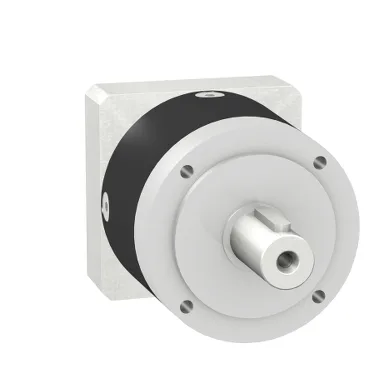
Planetary gearbox for servo-driven positioning axes
The GBX1600251385D is a straight-tooth planetary gearbox in the 160 mm frame size, delivering a 25:1 reduction ratio. It's built for the output side of a servo motor on a positioning axis — pick-and-place, rotary index tables, or feed-to-length on a cut-to-length line. Continuous output torque is 700 N.m, with a peak rating of 1120 N.m for acceleration transients. The 10 arc-min maximum torsional backlash means it holds position repeatability within a few thousandths of a degree at the output — acceptable for most servo-driven indexing, not for zero-backlash cam-follower applications.
Load capacity and service life at rated speed
Rated service life is 30,000 hours at 100 rpm output speed and 30 °C ambient. At that same speed, the maximum axial force on the output shaft is 6000 N, and the maximum radial force (applied at mid-shaft) is 4200 N — both for the full 30,000-hour life. If you need higher loads, the gearbox can handle 8000 N axial and 6000 N radial for a reduced 10,000-hour life. The torsional rigidity of 41 N.m/arcmin tells you how much wind-up you get under load — at 700 N.m continuous torque, expect about 17 arc-min of elastic twist. That's a known quantity for the servo tuning loop to compensate.
Sourcing reality — obsolete, sourced through surplus channels
Schneider Electric lists this gearbox as obsolete. The GBX series is a closed chapter — no direct drop-in replacement from Schneider. Available through independent surplus and broker channels. Quantities are lot-specific — confirmed at RFQ. No pin-compatible alternative exists within the same family; a functional replacement would require checking the mounting flange, shaft diameter, and keyway dimensions against a current-series planetary gearbox from a different manufacturer.
Integration and environmental fit
The housing is black anodized aluminium, shaft is C45 steel. IP54 at the shaft output — protected against dust ingress and splashing water, but not submersion or washdown. Mountable in any position — vertical, horizontal, or inverted — which simplifies integration into tight machine frames. The 5.81 g.cm² moment of inertia is low enough that a servo drive's inertia-matching calculation won't be dominated by the gearbox alone.