What the torque and backlash ratings mean for your drive train
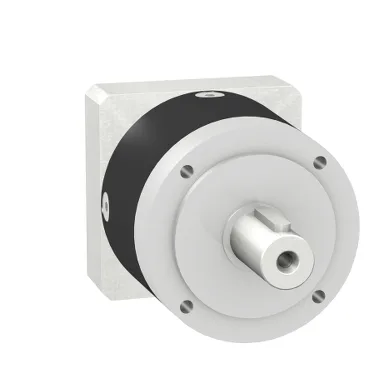
The GBX1600320701F is a straight-tooth planetary gearbox from Schneider Electric's GBX series, sized for servo and stepper motor applications that need a compact, high-ratio reduction in a 160 mm diameter package. Continuous output torque is 800 N.m at 100 rpm (30 °C), with a peak / emergency maximum of 1280 N.m at the same speed — the gap between continuous and max gives you headroom for transient overloads like acceleration or reversing loads, but you size the motor brake and coupling to the continuous figure for thermal stability. Maximum torsional backlash is 10 arc-minutes — this is a standard-precision grade, not a zero-backlash unit. For positioning axes that reverse direction under load, that 10 arc-min of lost motion shows up as a repeatability error; if your application needs tighter than that, you'd look at a preloaded or helical-tooth planetary.
Sourcing an obsolete GBX1600320701F — what to expect
This gearbox is sourced through independent surplus and broker channels. Quantities are lot-specific and confirmed at RFQ; availability and current pricing are quoted against your BOM line at the time of request. Because there is no direct drop-in replacement from Schneider, a functional replacement would likely require a different frame size or mounting interface — plan for a mechanical rework if you are substituting into an existing assembly.
Load capacity and service life under real-world forces
Rated service life is 30,000 hours at 100 rpm and 30 °C, with the gearbox lubricated for life — no maintenance oil changes, but the life clock starts at first run and the rating assumes clean, continuous duty within the torque envelope. Maximum axial force on the output shaft is 6000 N at 100 rpm for the full 30,000-hour life, or 8000 N if you accept a shorter 10,000-hour life. Maximum radial force (applied at mid-shaft) is 4200 N for 30,000 hours, or 6000 N for 10,000 hours. These are the limits for overhung loads like belt drives or pinions — exceed them and the output bearing life drops fast. Torsional rigidity is 41 N.m/arcmin — this tells you how much the gearbox winds up under load. At continuous torque (800 N.m), the wind-up is about 19.5 arc-minutes, which adds to the backlash figure for total positioning error under load.
Environmental fit and integration details
Shaft output protection is IP54 — sealed against dust ingress and splashing water, but not submersion. The housing is black anodized aluminium, the output shaft is C45 steel. Ambient operating range is -25 °C to 90 °C, so it handles most indoor industrial environments without derating. Noise level is 70 dB at 1 m, no-load — this is the gear mesh whine from straight teeth. Under load the noise will rise; if your application is noise-sensitive (near operator stations, sound-rated enclosures), a helical planetary would run quieter. Efficiency is 94 % at rated load — typical for a single-stage straight-tooth planetary. The 6 % loss is mostly friction and churning; it shows up as heat in the housing, so ensure the mounting surface and ambient airflow can sink that heat in a continuous-duty cycle.