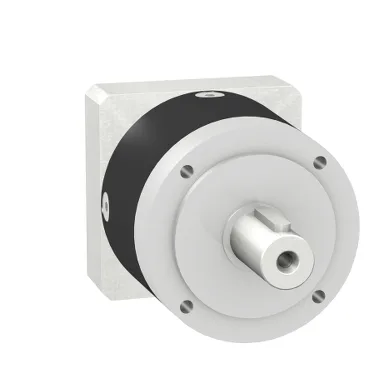
Sizing the GBX160 into the drivetrain
The GBX1600320844D sits in the GBX planetary line as a 32:1 reduction unit with a 160 mm housing, built to drop onto a Lexium or similar servo with a GBX-series mating flange and give a continuous 800 N.m at the output shaft while the gearbox itself tops out at 1280 N.m peak. Efficiency is rated 94 %, which is what you actually see at the shaft after the planetary stage has taken its cut — useful when the motor nameplate and the gearbox output have to balance on a conveyor or rotary table, and worth confirming against the application's average duty rather than the steady-state figure.
Mechanical envelope and bearing loads
Radial and axial loads on the output shaft are time-dependent, not single numbers — at 100 rpm the GBX tolerates 4200 N radial and 6000 N axial over a 30000-hour life at 30 °C, jumping to 6000 N radial and 8000 N axial if the designer is willing to accept a 10000-hour life at the same temperature. The 30000-hour figure at 100 rpm and 30 °C is the rating that drives pulley, pinion, and overhung-load sizing — anything that pushes the case temperature above the 30 °C reference shortens the L10 estimate, and the -25 to 90 °C operating envelope covers most factory floors without derating.
Backlash, stiffness, and what the drivetrain actually feels
Maximum torsional backlash is 10 arc.min with torsional rigidity of 41 N.m/arcmin, so positioning repeatability on a servo-driven axis is bounded by that 10-arc.min window and the wind-up under step loads. Moment of inertia at the input is 6.36 g.cm² — small enough that on a typical servo match it does not dominate the drive's acceleration budget, but worth checking against the motor's own Jm if the cycle time is aggressive.
Sealing, lubrication, and the field-service angle
The shaft output is sealed to IP54 and the gearbox is lubricated for life, which means no oil-change interval to schedule and no breather to mount — the trade-off is that the unit is a sealed assembly rather than a serviceable one, and bearing wear at end-of-life is a full-unit replacement. The housing is black anodized aluminium with a C 45 steel shaft, and the unit mounts in any position, so the bracket or flange design can be set by the cabinet layout rather than the gearbox.