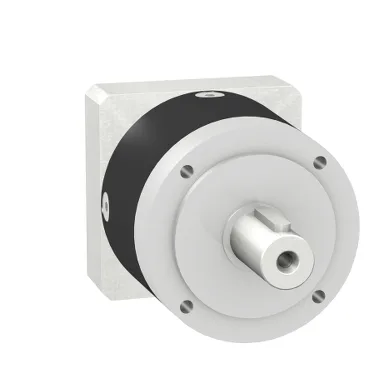
Is the GBX1600321081D still being built?
The GBX1600321081D sits in the GBX planetary family and carries an obsolete lifecycle flag on the manufacturer record, so any unit sold into a live build has to come out of surplus stock or independent distribution — there is no fresh-from-the-line production behind this code. For a procurement line that froze an obsolete order code on the BOM, the working assumption is independent supply rather than factory-direct ordering, with quantity and condition confirmed against the RFQ.
What the 32:1 and 800 N.m figure actually buys you
At a 32:1 reduction the gearbox converts the servo or stepper input into 800 N.m of continuous output torque and 1280 N.m at peak — the rating that decides whether the unit is sized for conveyor indexing, packaging rotary tables, or heavier indexing loads that spike into the peak figure during accel/decel. Maximum torsional backlash of 10 arc.min and torsional rigidity of 41 N.m/arcmin push this frame toward moderate-accuracy positioning tasks where some wind-up is acceptable, rather than high-stiffness precision gantry work.
Shaft loading and how long it lasts on the line
The output shaft accepts up to 4200 N radial at mid-span (30000 h reference at 100 rpm, 30 °C) and 6000 N axial under the same conditions, with a shorter 10000 h envelope allowing 6000 N radial / 8000 N axial — the radial figure almost always decides the fit, because pulley and pinion overhang loads reach that limit before the torque rating does. Service life is specified at 30000 h at 100 rpm and 30 °C ambient, with the box lubricated for life and sealed to IP54 at the shaft exit — a sealed-for-life planetary that does not want a grease port on the maintenance schedule.
Mounting, envelope and ambient limits
The 160 mm frame fits any mounting position, with a C 45 output shaft and an operating envelope of -25...90 °C — the high end of that range is what cuts in derating, because most lubrication life curves assume cooler surroundings than the spec ceiling. Reported no-load noise is 70 dB at 1 m, an integration note for line-side acoustic budgeting rather than a selection parameter — efficient at 94 % at rated duty, so the waste heat stays manageable inside that ambient window.