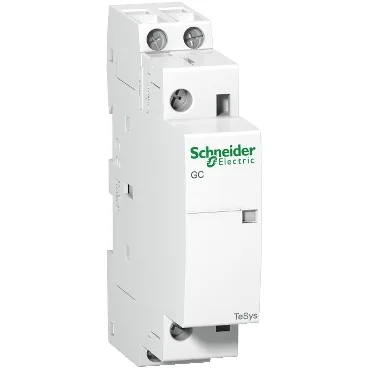
The Schneider Electric GC1620M6 is a TeSys GC modular contactor — a 2-pole (2P) device rated for AC-7A and AC-7B utilisation categories, meaning it is designed to switch motor loads, resistive heating, and lighting circuits in commercial or light industrial panels. The control coil is wound for 220…240 V AC at 60 Hz, with a dropout threshold of 0.2…0.75 Uc and an operating range of 0.85…1.1 Uc at 50 Hz (below 50 °C). Rated breaking capacity is 40 A at 400 V per IEC 61095, and the making capacity matches at 40 A AC — so it can close into a motor starting current without welding its main contacts, provided the upstream fuse is a 16 A gL type at ≤440 V for the power circuit. Electrical durability is specified at 100,000 cycles for both AC-7A and AC-7B duty, with mechanical durability rated at 1,000,000 cycles.
The contactor clips onto a standard 35 mm DIN rail (mounting mode: clip-on) and occupies a single 18 mm module width — 17.5 mm wide, 81 mm tall, 62.5 mm deep. The IP20 finger-safe rating (per VDE 0106) applies out of the enclosure; inside a panel it achieves IP40. Screw-clamp terminals accept up to 6 mm² solid or flexible on the power circuit and 2.5 mm² on the control circuit, with a tightening torque of 0.8 N.m on both. The 1.3 W heat dissipation at 50/60 Hz means a row of these on a DIN rail needs reasonable ventilation but no forced cooling in a typical enclosure.
Designed and tested to IEC 61095 (household and similar electromechanical contactors) and IEC 60947-5 (control circuit devices). The operating altitude is ≤3000 m without derating, and the contactor withstands 10 Gn shock (open) and 15 Gn (closed) at 11 ms, plus vibration of 2 Gn (open) and 3 Gn (closed) across 5…300 Hz.