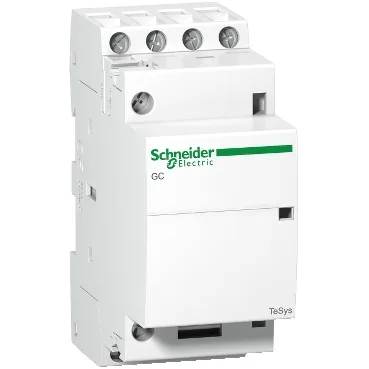
The GC2504M6 is a 4-pole modular contactor from the Schneider Electric TeSys GC series, rated for 25 A in AC-7A and AC-7B utilisation categories — meaning it's built for switching motor loads, resistive heating, and lighting circuits in commercial or light industrial panels. The control coil is wound for 220-240 V AC at 60 Hz, with a drop-out threshold between 0.2 and 0.75 Uc and a pick-up range of 0.85 to 1.1 Uc at 50 Hz, so it stays latched through moderate sags but drops cleanly on undervoltage. Clip it onto a DIN rail (35 mm per EN 60715) and it occupies two 18 mm module widths — 36 mm total — which is a standard footprint for modular contactors in distribution boards.
The continuous thermal current (Ith) is 25 A, and the average impedance per pole is 2.5 mOhm at 50 Hz, so expect about 1.6 W heat dissipation per pole at rated current. That heat has to go somewhere: the contactor is rated IP20 with the terminals exposed (finger-safe only in an enclosure) and IP40 inside a cabinet, so keep ventilation slots clear and don't stack modules tighter than the 300 cycles/hour maximum operating rate at 50 °C. Electrical durability is rated at 100,000 cycles for both AC-7A and AC-7B duty; mechanical durability is 1,000,000 cycles — the contactor will outlast the application's electrical life if you're switching resistive loads, but motor starts will wear the contacts faster.
Terminals are screw-clamp type on both control and power circuits. Power circuit accepts up to 6 mm² solid or flexible (with or without ferrule) — two cables per terminal up to 4 mm² flexible without ferrule. Control circuit is limited to 2.5 mm². Tightening torque is 0.8 N.m for both circuits, which is a common value for this terminal class — a standard electrician's screwdriver with a torque-limiting handle will get it right.
The GC2504M6 is designed and tested to IEC 61095 (household and similar electromechanical contactors) and IEC 60947-5 (control circuit devices and switching elements). Associated fuse rating for the power circuit is 25 A gL at up to 440 V — so if you're coordinating with upstream protection, a 25 A gL/gG fuse or a 25 A C-curve MCB is the correct match. The contactor also meets mechanical robustness requirements: 10 Gn shocks when open, 15 Gn when closed, and vibration resistance up to 3 Gn at 5-300 Hz when closed — which covers most industrial panel vibration profiles.