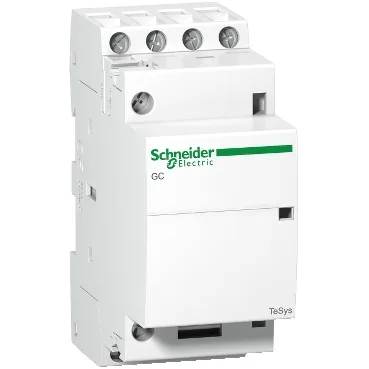
It occupies 2 modules of 18 mm width each, so it fits standard 36 mm-wide consumer-unit or panel slots. The control circuit is 110 V AC at 60 Hz, making it a direct drop-in for North American 60 Hz control voltages. Rated under IEC 60947-5 and IEC 61095, this contactor is listed for utilisation categories AC-7A and AC-7B. That means it is certified for switching motor loads, heating elements, and lighting circuits — the three applications explicitly named in the spec. The 68 A rated making and breaking capacity at 400 V (per IEC 61095) confirms it can handle inrush from small motors and transformer loads without contact welding.
The utilisation category AC-7A covers resistive and lightly inductive loads (heating, lighting), while AC-7B covers motor loads. Electrical durability is rated at 100,000 cycles for both categories, with mechanical durability at 1,000,000 cycles. For a panel builder, that means this contactor is suited for applications with moderate switching frequency — the maximum operating rate is 300 cycles per hour at 50 °C. Heat dissipation is 1.6 W at 50/60 Hz, which is low enough that no special ventilation is needed in a standard enclosure. The average impedance of 2.5 mOhm on the power circuit (at Ith 25 A, 50 Hz) keeps voltage drop negligible. The associated fuse rating is 25 A gL at ≤ 440 V — a standard Class gL cartridge fuse protects the power circuit. IP20 protection (per VDE 0106) applies to the contactor body when mounted in an enclosure; IP40 when inside a closed panel. The protective treatment is coded TC, which is the standard tropicalisation coating for humidity resistance — not a heavy-duty marine coating, but adequate for most indoor industrial environments.
The operating position allows up to 30° from vertical, so it can be mounted on a slight angle in a tight enclosure. Screw-clamp terminals on both control and power circuits, with a uniform tightening torque of 0.8 N.m. Power circuit terminals accept up to 6 mm² solid or flexible cable (1 cable) or 2 x 4 mm² flexible without cable end. Control circuit terminals accept up to 2.5 mm² flexible.