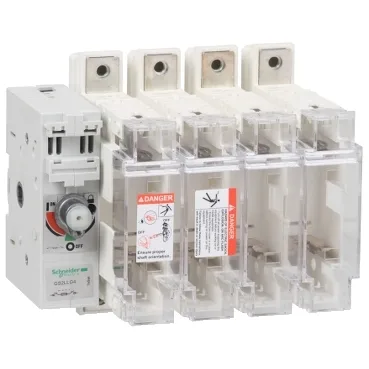
The Schneider Electric GS2LLG4 is a TeSys GS switch-disconnector-fuse, a 4-pole unit rated for 160 A at 400 V AC-23A/AC-23B and 125 A at 690 V in the same duty classes. It accepts DIN fuse links size 00 and is designed for plate mounting in a panel or enclosure. The 160 A conventional free-air thermal current (Ith) at 40 °C is the baseline for sizing conductors and enclosure ventilation — the AC-23B making capacity of 1600 A at 400 V and breaking capacity of 1280 A at 400 V confirm it can close onto and interrupt motor starting currents within its rating.
Rated operational power reaches 80 kW at 400 V, 110 kW at 500 V, and 110 kW at 690 V — the power limit is set by the fuse size and thermal capacity, not the switch body. Short-circuit withstand is 22.7 kA, and with gG fuse protection the rated short-circuit making capacity (Icm) is 80 kA at 400 V. The rated insulation voltage (Ui) is 750 V AC, and impulse withstand (Uimp) is 8 kV, so it suits 690 V line-to-line systems with adequate clearance. IP20 with the terminal cover is touch-safe but not washdown-rated — keep it inside a panel.
This part is marked obsolete by the manufacturer. The 160 A 4-pole switch-disconnector-fuse function can be replaced by a current-production TeSys GS or TeSys island equivalent, but pin-to-pin compatibility and mounting footprint must be verified per the specific panel layout.
Plate-mounted, 240 mm wide by 162 mm high by 136.5 mm deep. Power circuit terminals accept bars up to 20 mm² or lugs/ring terminals from 50 to 95 mm²; tightening torque is 12 N·m. The external left-side operating handle is included. Fuse size 00 DIN links are standard and widely available.
Environmental and durability
Fire resistance meets 850 °C on the fuse cover and 960 °C on the body per IEC 60695-2-1. Mechanical durability is 10,000 cycles; electrical durability is 1,000 cycles in AC-23A/AC-23B and 200 cycles in DC-23A/DC-23B. The 4 NO contacts are all normally open.