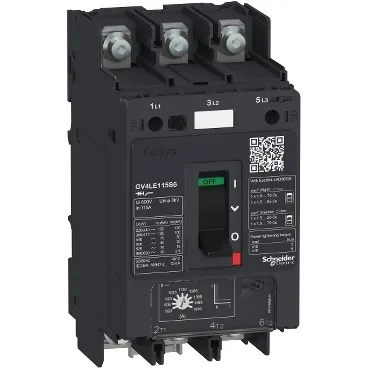
It combines magnetic and electronic trip technology, with a rated current [In] of 3.5 A and a magnetic tripping range of 21 to 49 A. The breaking capacity hits 100 kA Icu at 240 V AC, dropping to 50 kA at 415 V and 8 kA at 690 V. That means this breaker clears faults up to 100 kA without upstream fuses or cascading failures — critical for high-fault installations like transformer-fed MCCs. This is a motor circuit breaker, not a plain branch-circuit breaker: the trip curve is shaped for motor inrush and overload profiles. The utilisation category is AC-3 per IEC 60947-4-1, meaning it's rated for switching squirrel-cage motors — starting, stopping, and running isolation. It also meets Category A per IEC 60947-2 for short-circuit performance.
Connection pitch is 27 mm without spreaders, 35 mm with. Terminals accept lugs or ring terminals; tightening torque is 9 N·m for cable 16 to 95 mm², 5 N·m for 1.5 to 10 mm². IP40 front-of-panel protection; IK07 impact resistance. Operating altitude up to 5000 m, any mounting position.
Rated current 3.5 A [In] sets the continuous thermal rating — the breaker will carry 3.5 A indefinitely at 40 °C ambient without tripping. The motor power table shows it protects motors from 0.55 kW up to 2.2 kW depending on voltage: 0.55 kW at 400 V, 1.1 kW at 690 V. That's a wider band than a fixed-thermal breaker because the electronic trip adjusts to the motor FLA setting. Power dissipation per pole is 6.1 W — three poles total 18.3 W at full load, which matters for enclosure thermal rise calculations. Electrical durability is rated at 40,000 cycles under AC-3 at 440 V — both at full load current and at half load. This is a moderate-duty industrial breaker, not a high-cycle machine-tool contactor; it's designed for motor start/stop service in conveyors, pumps, and fans, not for rapid jogging or high-frequency switching.
It carries a fire-resistance rating of 960 °C per IEC 60695-2-11. Climatic withstand conforms to IACS (marine and offshore environmental testing). Storage temperature range is -50 to 85 °C; operating ambient is not explicitly listed but the continuous-duty rating implies standard 40 °C enclosure conditions.