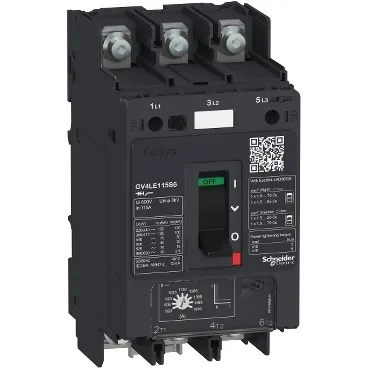
It's a 3-pole unit with a rated current of 7 A and uses a combined magnetic and electronic trip unit technology. Its primary job is to protect motor feeders against short-circuits and overloads, and it's rated for continuous duty per IEC 60947-4-1. The magnetic trip is adjustable between 42 and 98 A, covering a range of motor sizes. The breaker is rated for isolation per IEC 60947-1, meaning it can be used as a disconnecting means in the motor branch circuit.
The headline breaking capacity is 100 kA Icu at 220-240 V AC, which drops to 50 kA at 380-415 V and 15 kA at 525 V. The motor power ratings span from 1.5 kW at 400 V up to 7.5 kW at 690 V, so it fits a range of small to medium induction motors. For a 400 V line, it covers 1.5 to 3 kW motors depending on the exact rating. Utilization category is AC-3 per IEC 60947-4-1, which is the standard for squirrel-cage motor starting — switching motors during running, not just isolating them. It's also Category A per IEC 60947-2 for general circuit protection. Electrical durability is rated at 40,000 cycles under AC-3 at 440 V, both at full load and at half load. Mechanical durability matches at 40,000 cycles. That's a solid service life for a motor starter duty cycle in most industrial applications. Power dissipation per pole is 6.1 W, so total heat load in the enclosure is about 18.3 W.
Dimensions are 155 mm high, 81 mm wide, and 116 mm deep. It's designed for panel mounting with lugs or ring terminals, accepting cables from 1.5 to 95 mm². Tightening torque is 9 N.m for the larger cable range and 5 N.m for the smaller. The connection pitch is 27 mm without spreaders, or 35 mm with them — useful to know when laying out busbars or cable ducts in the enclosure. IK07 impact resistance handles light mechanical knocks during installation.
The GV4LE07N6 complies with EN/IEC 60947-2 (circuit-breaker standard) and EN/IEC 60947-4-1 (contactor and motor-starter standard). It also meets IEC 60695-2-11 for glow-wire fire resistance at 960 °C, and IACS for climatic withstand.