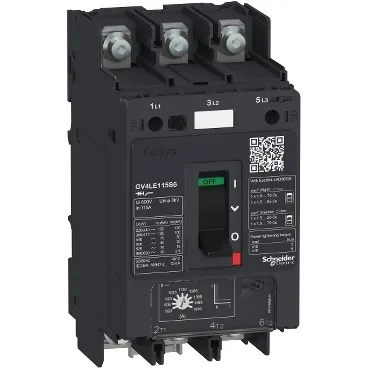
It combines magnetic and electronic trip technology to protect motor circuits against short-circuits and overloads, with a magnetic tripping window of 42...98 A. Rated for AC-3 duty per IEC 60947-4-1, it handles the high inrush of squirrel-cage motors during starting and the lower running current under load. The 7 A frame covers motor outputs from 1.5 kW up to 7.5 kW depending on supply voltage (400 V to 690 V AC). Breaking capacity reaches 120 kA Icu at 240 V AC and 100 kA at 415 V AC per IEC 60947-2, meaning it can safely interrupt a fault current up to that level without welding contacts or cascading damage upstream. This is a strong SCCR for a 7 A frame — suitable for high-fault installations.
The GV4L footprint is 81 mm wide, 155 mm high, and 116 mm deep — a compact 3-pole block that mounts on a DIN rail or panel. Connection pitch is 27 mm without spreaders, widening to 35 mm with spreaders for larger cable lugs. Terminal tightening torque is 9 N·m for the main power cables (16...95 mm²) and 5 N·m for control wiring (1.5...10 mm²). IP40 front protection and IK07 impact resistance suit it for enclosed panel installation where occasional tool drops or debris are a risk.
For motor protection, you size this to match the motor's full-load current, not the nameplate kW. The magnetic trip setting of 42...98 A is fixed and non-adjustable — it must fall above the motor's starting inrush to avoid nuisance trips. Electrical durability is 40,000 cycles at AC-3 duty at 440 V — a solid service life for a motor-starter application. Mechanical durability matches at 40,000 cycles. Maximum operating rate is 25 cycles per hour, so it is not intended for high-speed jogging or rapid cycling. Power dissipation per pole is 6.1 W, totaling about 18.3 W for the three poles at full rated current. This matters for thermal management inside a sealed enclosure — check the cabinet's temperature rise if multiple breakers are ganged together.