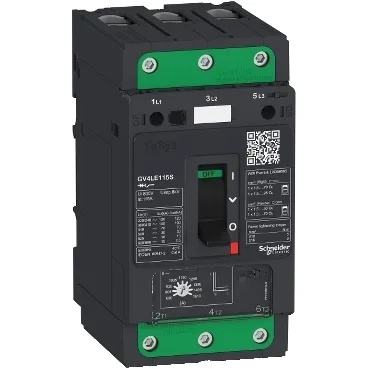
It's a 3-pole device with a magnetic-electronic trip unit — the magnetic part handles short-circuit trips (150...350 A threshold), while the electronic side manages overload protection. At 400 V you get 25 kA, still enough for most industrial distribution. That's the utilisation category that matters for motor switching — AC-1 resistive loads would be easier, but AC-3 is what you need for direct-on-line motor starts.
The GV4LE25B is a panel-mount device — no DIN-rail clip on this one. It bolts into the enclosure on a mounting plate. Dimensions are 155 mm high, 81 mm wide, 116 mm deep. That 81 mm width is three pole spaces wide on a standard 27 mm/module grid, so it takes up the same footprint as a typical 3-pole contactor in the TeSys range. Terminals are EverLink BTR screw connectors. Top side accepts 1.5...70 mm² solid or 1.5...50 mm² flexible; bottom side takes 2.5...95 mm² solid or 2.5...70 mm² flexible. Tightening torque is 9 N·m for the larger cables (16...95 mm²) and 5 N·m for the smaller ones (1.5...10 mm²). That's a standard torque driver setting — no special tooling needed. IP40 protection means it's for indoor use in a closed panel — not for washdown areas or outdoor cabinets without a secondary enclosure. IK07 impact resistance handles light knocks during panel assembly, but don't drop a wrench on it.
Compliance documentation is straightforward: it carries EN/IEC 60947-2 (circuit-breaker standard) and EN/IEC 60947-4-1 (motor-starter standard) approvals. That covers both the overcurrent protection and the motor-switching duty in one device.
The 25 A rated current is the headline number, but the motor power table tells you what motor it actually drives: 5.5 kW at 400 V, 7.5 kW at 500 V, up to 18.5 kW at 690 V. Electrical durability is 40,000 cycles at AC-3 with half-rated current, and 20,000 cycles at full rated current. That's the mechanical life of the contacts under motor-switching duty. For a panel that cycles a conveyor motor once every two minutes, that's roughly 67 days of continuous operation at full load — plan spares accordingly if your duty cycle is high. The magnetic trip range of 150...350 A is adjustable (via internal settings) and sets the instantaneous short-circuit threshold. That's roughly 6 to 14 times the rated current — typical for motor inrush. If your motor's locked-rotor current is near the low end of that range, you may need to dial the trip up to avoid nuisance trips on start.