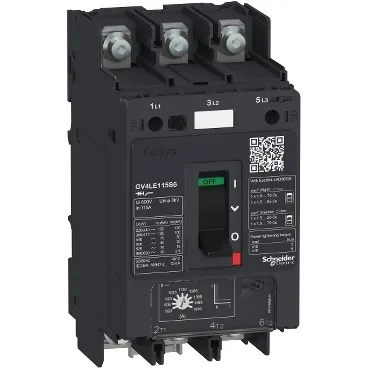
It combines magnetic and electronic trip technology to handle both short-circuit and overload protection for a single motor branch. Rated operational voltage is 690 V AC, with an insulation voltage of 800 V AC, and it carries a breaking capacity of 50 kA Icu at 220-240 V AC, 25 kA at 380-415 V, and 10 kA at 500 V — all per IEC 60947-2. Motor power ratings span 22 kW to 55 kW depending on supply voltage: 37 kW at 400-415 V, 45 kW at 500 V, and 55 kW at 660-690 V. The utilisation category is AC-3 per IEC 60947-4-1, so it's rated for switching squirrel-cage motors during starting and running — the standard duty for motor starters.
The magnetic trip threshold is set at 480-1120 A (6-14x In), which is a wide adjustable band for motor inrush. That range covers typical starting currents for a 37 kW motor on 400 V without nuisance tripping, but you'll want to set it at the low end for a soft-start or high-inertia load. Electrical durability is 14,000 cycles at AC-3 at 440 V at half rated current, and 7,000 cycles at full rated current — that's the cycle life for a frequently started conveyor or pump. That's fine for most process applications but not for a high-speed pick-and-place or a stamping press that cycles every few seconds. Power dissipation per pole is 6.1 W, so at 80 A continuous you're looking at about 18 W total heat inside the enclosure — factor that into panel cooling if it's a dense layout. This is a panel-mount part, not a field-mount standalone enclosure.
Installation and integration notes
Mounts in any position, operates up to 5000 m altitude. Connection pitch is 27 mm without spreaders, 35 mm with spreaders — that matters when you're laying out a multi-motor panel and need to align busbars or comb bus. Terminals accept lugs or ring terminals; tightening torque is 9 N.m for 16-95 mm² cable, 5 N.m for 1.5-10 mm². That saves a separate disconnect switch in many panel designs. Fire resistance is 960 °C per IEC 60695-2-11, which is the glow-wire test for plastic enclosures in fault conditions.