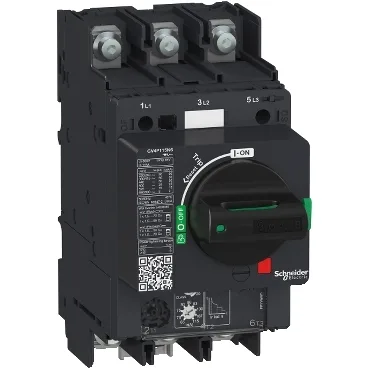
Breaking capacity that covers the fault-current map
The GV4P50N6: At 240 V AC the Icu is 100 kA per IEC 60947-2, dropping to 50 kA at 415 V and 25 kA at 500 V. Under UL 60947 the 480Y/277 V rating is 35 kA. These are not theoretical maximums — they are the tested interrupting ratings that let you coordinate downstream without cascading failure. The 50 A line current coupled with an 850 A magnetic trip threshold means the short-circuit release is set at 17× In, which sits above motor inrush but below the fault current the supply can deliver. That selectivity window is what keeps a single motor fault from taking out the whole panel.
AC-3 motor duty and thermal budget
Rated utilisation category AC-3 per IEC 60947-4-1 — this is the standard for squirrel-cage motors with starting currents up to 8× In. The GV4P50N6 covers 11 kW at 400 V and up to 45 kW at 690 V, which brackets the common IEC motor frame sizes from 132 to 225. Power dissipation is 4.6 W per pole. In a closed panel with multiple breakers ganged, that 13.8 W three-phase heat adds up — the IP40 enclosure assumes free air, so derate the grouping factor if you pack them tighter than the 27 mm pole pitch without spreaders.
Dimensions are 3.2 in wide × 6.1 in tall × 6.5 in deep (81 × 155 × 165 mm). The 27 mm pole pitch matches the standard TeSys Deca busbar grid; with spreaders it opens to 35 mm for larger cable lugs. Terminals accept lugs or ring terminals: the main circuit takes 16–95 mm² at 9 N·m, the control circuit 1.5–10 mm² at 5 N·m. That covers both the motor feeder and the control wiring in one terminal block.
Approvals and compliance for global panels
The fire-resistance glow-wire test passes at 960 °C per IEC 60695-2-11. Pollution degree 3 means it is rated for the conductive-dust environment inside a typical industrial enclosure.