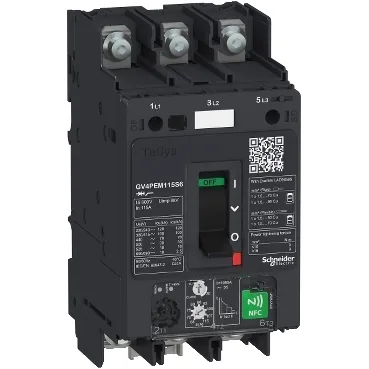
50 A motor circuit breaker with global short-circuit ratings
The GV4PEM50S6: It sits in the TeSys Deca range and is designed for motor protection in industrial control panels. These numbers mean it clears high-fault currents without upstream coordination headaches in most industrial distribution systems. The magnetic trip threshold is set at 850 A — roughly 17× In — which keeps the breaker from nuisance-tripping on motor inrush while still catching bolted faults early.
Motor power coverage spans 11 kW at 400 V up to 45 kW at 690 V, making this one breaker cover a wide motor range depending on your line voltage. The AC-3 utilisation category confirms it is rated for switching squirrel-cage motors — the standard duty for a motor circuit breaker. Phase failure sensitivity per IEC 60947-4-1 protects the motor from single-phasing damage when one supply line drops. The electronic trip detects the imbalance and opens before the motor overheats. Suitability for isolation per IEC 60947-1 means this breaker can serve as a visible-break disconnect for safe maintenance — no separate isolator needed upstream. Power dissipation is 4.6 W per pole, totalling 13.8 W at full load. Budget this into enclosure thermal calculations to avoid derating when multiple breakers are ganged in a small panel.
Panel fit and termination details
Dimensions are 3.2 in wide × 6.1 in high × 4.6 in deep (81 × 155 × 116 mm). The connection pitch is 27 mm without spreaders and 35 mm with spreaders — important when laying out busbars or lug kits across multiple breakers on a DIN rail. Terminals accept lugs or ring terminals: 1.5-10 mm² at 5 N·m torque, and 16-95 mm² at 9 N·m. The larger lug range handles the full 50 A load with standard power conductors. IP40 protection means it is suited for dry indoor panels only — not for washdown or outdoor enclosures without additional cabinet protection. IK07 impact resistance handles incidental tool bumps during installation.
Lifecycle and compliance — active, not legacy
This covers North American and European installations without additional certification paperwork. Fire resistance tested to 960 °C per IEC 60695-2-11, pollution degree 3, and operating altitude to 5000 m — all standard industrial environment ratings that match typical factory floor conditions.