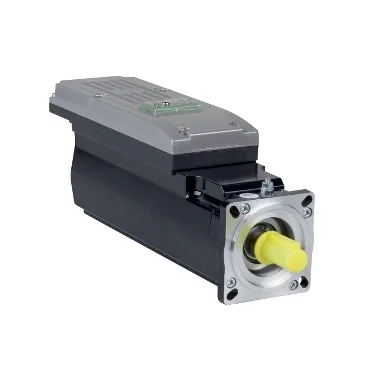
PacDrive 3 ILM motor with the drive already inside
The Schneider Electric ILM0701P11F0000 is a servo motor with an integrated drive from the PacDrive 3 family — the controller electronics are tucked into the back of a 70 mm flange servo, so a motion axis collapses into one mechanical package rather than separate drive cabinet + motor + cable run. Its ILM device short name and 70 mm flange carry the standard mounting interface used across the PacDrive 3 ILM series, which is the angle most retrofit jobs care about before the rest of the ratings matter.
Torque envelope: 0.5 N.m working, 3 N.m parked
Continuous stall torque is 1.1 N.m and nominal torque is 0.5 N.m, with a peak stall ceiling of 3.5 N.m — that three-to-one ratio between continuous and peak is what governs the dynamic headroom for short accel/decel moves in a packaging or pick-and-place axis. A holding brake rated 3 N.m comes fitted, sized to hold the same peak figure statically, so the motor parks locked without an external safety brake on a vertical or tilt axis.
Speed, electrical constants and rotor inertia
Nominal speed is 6000 rpm and continuous line current sits at 0.6 A — modest electrical demand, so the integrated drive does not need a separate cabinet feed beyond the PacDrive DC bus. Stator resistance is 10.4 Ohm phase-to-phase at 20 °C dropping to 7.23 Ohm phase-to-neutral at 120 °C, with 38.8 mH inductance (Ph/Ph) at 20 °C — useful numbers when sizing the drive loop bandwidth or predicting I²R heating in continuous-duty cycles. Nominal output power is 310 W, and the back-EMF constant is 46 V/krpm at 20 °C — the latter tells you roughly what DC bus the integrated drive is expecting for full speed without field weakening.
Feedback and shaft interface
Feedback is absolute single-turn SinCos Hiperface, which means absolute position survives a power cycle and the drive comes back up with axis coordinates already known — important on a retrofit where homing routines are a nuisance to re-run after every E-stop. The shaft is keyed with an 11 mm diameter, 23 mm length, 18 mm key width, and there is no second shaft end — the rear face is occupied by the drive electronics rather than a resolver pigtail or a second output for a gearbox.
Bearing loads, sealing and cooling
Maximum radial force Fr tapers from 660 N at 1000 rpm down to 360 N at 6000 rpm, with a maximum axial force Fa limited to 0.2 × Fr — the bearing budget erodes fast as speed rises, so a belt or pinion geometry that seems fine on paper at low speed can crowd the limit once the line ramps up. Cooling is natural convection rather than a forced-air fan, and the sealing is IP54 — which keeps the motor happy in a panel-internal or light-dust setting but rules out washdown food-and-bev cells unless the motor sits behind its own enclosure.