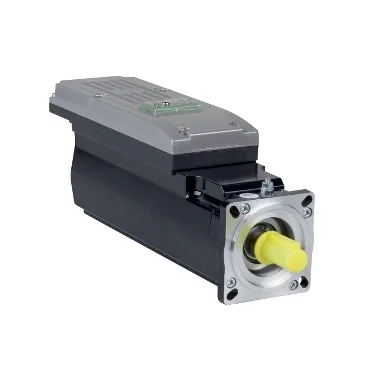
Integrated drive motor in the PacDrive 3 ILM frame
The Schneider Electric ILM0702P21F0000 is a servo motor with an integrated drive from the PacDrive 3 ILM family — a 70 mm flange, 252 mm-long unit that combines the motor and drive electronics in one housing rather than pairing a separate servo amplifier to a standalone motor. The 720 W nominal output and 1.15 N·m continuous torque sit at the low end of the ILM range, sized for compact packaging machines, small indexing tables, and feeder axes where a distributed drive cabinet adds more wiring than it saves.
Torque, speed, and the 1.5 A / 11.8 A current envelope
Continuous torque of 1.15 N·m against a 7.6 N·m peak stall gives roughly a 6.6× overload headroom — enough for short accel ramps without the drive tripping into I²T foldback, which matters for pick-and-place moves where the cycle time is dominated by the acceleration phase, not the steady-state run. Nominal speed is rated to 6000 rpm with a continuous line current of 1.5 A and a peak Irms of 11.8 A; the torque constant of 0.76 N·m/A at the 120 °C winding temperature lets the integrator back-calculate the current command needed for a given torque setpoint without trusting the default motor map. Back-EMF constant of 48 V/krpm at 20 °C and the 4.2 Ω phase-to-phase stator resistance at room temperature are the loop-tuning inputs — the drive uses them to model the electrical time constant, and any deviation in the measured winding resistance at install usually points to a cold-soak problem or a cable fault rather than a bad motor.
Feedback, brake, and the Hiperface single-turn return
Position feedback is a Hiperface SinCos single-turn absolute encoder — absolute to one turn, so the controller reads true shaft angle on power-up without a homing move, which removes one failure mode on vertical or unbalanced axes where a homing sequence after every E-stop would be unacceptable. The integrated holding brake is rated 3 N·m holding torque, sized to hold the rotor with the rated continuous torque applied at the shaft rather than to arrest a moving load — the brake is a parked-axis safety, not a dynamic stop, and any rapid-stop duty must come from the drive's regenerative or resistive path.
IP65 sealing, natural convection, and where it mounts
Cooling is natural convection — no fan, no blower path — and the housing carries an IP65 rating, meaning the unit survives low-pressure water jets and dust ingress and can sit on a machine frame near coolant splash or in a washdown-adjacent zone without an additional enclosure shroud, provided the cable glands and feedback connector are also sealed to the same rating. Mounting is the international standard flange pattern with a 60 mm centring collar, four 5.5 mm mounting holes, and a 70 mm flange square — the motor bolts directly to a standard gearhead or face-mount bracket without an adapter plate, and the 11 mm untapped shaft accepts a keyed coupling or pinion with a standard retaining method. Radial shaft load is derated against speed — 710 N at 1000 rpm stepping down to 390 N at 6000 rpm — with axial force capped at 0.2× the applied radial; a belt drive running near the top of the speed range must be tensioned conservatively, otherwise the bearing life curve on the nameplate starts to slip below the planned maintenance interval.