Form factor and what the flange gives you
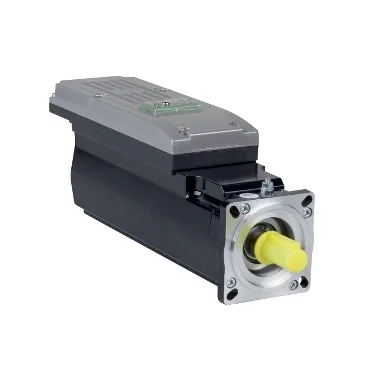
The Schneider Electric ILM0702P22A0000 is a servo motor integrated drive from the PacDrive 3 range, with the ILM short name — the drive electronics live inside the motor housing rather than in a separate cabinet amplifier, so the cabinet-side wiring collapses to power in, fieldbus out, and feedback to the controller. Overall length is 8.9 in (226 mm) on a 2.8 in (70 mm) flange — a short-stack frame that fits where a separate servo + amplifier pair would not, with a 60 mm centring collar and four 5.5 mm mounting holes on the international standard flange pattern.
Torque, speed and the 720 W working envelope
Continuous torque is 1.15 N·m nominal (10.18 lbf.in) with a continuous stall torque of 1.7 N·m (15.05 lbf.in), and peak stall reaches 7.6 N·m (67.3 lbf.in) — the 6.6× ratio between peak and continuous is what lets the motor accelerate inertial loads and survive short-term overload events without tripping the drive. Rated nominal speed is 6000 rpm at 720 W output power — sizing the load against this point matters more than the headline wattage, because above 6000 rpm the motor runs into field-weakening and the available torque drops.
Shaft, bearings and the radial load ceiling
The shaft is 11 mm diameter (0.4 in), 23 mm long (0.9 in), untapped, no second shaft end, no holding brake — direct-coupling or pulley-mount only, with no fail-safe parking torque if the bus drops, so the mechanical side must back-stop the axis. Maximum radial load Fr falls from 710 N at 1000 rpm to 390 N at 6000 rpm, with maximum axial force Fa capped at 0.2 × Fr — a belt or gear on the shaft end needs to be dimensioned against the speed-dependent Fr curve, not a single static figure.
Feedback, poles and the electrical face
Feedback is absolute multiturn SinCos Hiperface with 128 periods of speed feedback resolution on a 6-pole rotor — Hiperface is the protocol that lets the drive read absolute position on power-up without a homing routine, which matters on machines that cannot tolerate a return-to-reference move at every restart. Line-rated current is 1.5 A continuous with a continuous stall current of 2.5 A and a maximum Irms of 11.8 A — the Irms ceiling is the short-term peak the drive will deliver before folding back, and it scales with the 7.6 N·m peak torque figure above. Back-EMF constant is 48 V/krpm at 20 °C, so a coasting motor at 6000 rpm will generate roughly 288 V across the phases — the DC bus must be sized to absorb or the drive will trip on overvoltage.
Sealing, cooling and what IP65 really buys
Cooling is natural convection with no integrated fan, so the motor depends on a clean, unblocked housing surface — mounting it inside a sealed cabinet without clearance will throttle the continuous rating. IP65 sealing on the housing means dust-tight and resistant to low-pressure water jets, which opens the door to food-adjacent lines, machine-tool enclosures with coolant splash, and outdoor cabinets — but it does not cover high-pressure washdown or temporary immersion.