Reading the torque envelope and where the 2.9 N.m rating actually lives
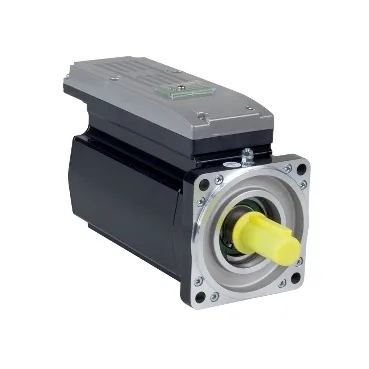
The ILM1002P32A0000: Continuous stall torque lands at 38.9 lbf.in (4.4 N.m) and peak stall torque at 162.0 lbf.in (18.3 N.m), while the nominal point sits at 25.7 lbf.in (2.9 N.m) at 3000 rpm — that is the figure to size the steady-state load against, with the 18.3 N.m peak available only for short accel/decel bursts. Continuous stall current is 2.9 A and maximum current Irms is 13.1 A, so the drive sizing question is really about the 13.1 A peak channel rather than the 2.9 A nominal — confirm the PacDrive controller module can source that transient without tripping on the drive's I²t window.
Power, back-EMF, and how fast this ILM can actually spin
Feedback is Absolute multiturn SinCos Hiperface with a 128-period speed feedback resolution, which means commutation starts the moment the drive powers up — no homing move needed on every cold start, a real win for machines where the absolute position must survive a power cycle.
Shaft loading, flange fit, and the radial force that decides bearing life
Maximum radial force Fr derates with speed: 990 N at 1000 rpm, 790 N at 2000 rpm, 690 N at 3000 rpm, and maximum axial force Fa is capped at 0.2 x Fr — so a belt or pinion drive mounted outboard of the 1.6 in (40 mm) shaft has to be re-checked at the top speed, not just at the rated point, or the bearing life estimate is optimistic. Mounting is an international standard flange, 3.9 in (100 mm) motor flange size, with a 3.7 in (95 mm) centring collar 0.1 in (3.5 mm) deep and four 0.4 in (9 mm) mounting holes — that is the standard ILM bolt pattern, so a machine redesign onto a different PacDrive 3 frame can reuse the existing adapter plate.
Thermal model, sealing, and the rotor numbers behind the curve
Stator resistance shifts from 4.12 Ohm Ph/Ph at 68 °F (20 °C) to 2.86 Ohm Ph/N at 248 °F (120 °C), and stator inductance from 21.8 mH Ph/Ph at 68 °F (20 °C) to 10.9 mH Ph/N at 248 °F (120 °C) — warm-winding copper behaves very differently from cold, so a regulator tuned on a bench at room temp will look sluggish once the motor reaches its working temperature.