What lands in the cabinet
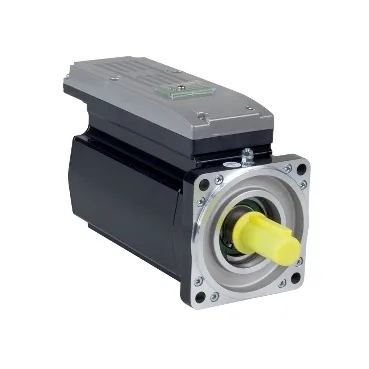
The ILM1002P32F0000 is a Schneider Electric PacDrive 3 ILM series servo motor integrated drive — the drive electronics sit on the back of the motor, so the unit drops into a panel as a single package rather than as a separate drive and motor pair. At 910 W nominal output power with a 100 mm flange and natural-convection cooling, it is sized for the compact machine axis — packaging, small-format converting, indexing tables, and similar mid-range motion loads rather than heavy gantry work.
Torque envelope and current draw
Nominal torque is 2.9 N·m at 2 A line-rated current; peak stall torque reaches 18.3 N·m at the maximum Irms of 13.1 A — roughly a 6.3× overload margin over the continuous rating, which is the budget for short accel/decel pulses typical of PacDrive 3 point-to-point moves. Continuous stall torque is 4.4 N·m at 2.9 A — higher than the nominal running torque because the natural-convection case can shed more heat at zero rpm with no rotor losses than it can at the 3000 rpm nominal speed.
Feedback, shaft, and brake
Absolute multiturn SinCos Hiperface feedback on a keyed 19 mm shaft, 40 mm long, with an integrated holding brake rated 5.5 N·m — the brake locks the axis on power-loss without a separate brake resistor or external spring-set unit. Back-EMF constant of 100 V/krpm at 20 °C and torque constant of 1.52 N·m/A at 120 °C set the drive sizing — the drive bus voltage must clear the back-EMF at top speed (≈300 V at 3000 rpm), which matters when the PacDrive 3 DC bus is shared with other axes.
Environment and shaft load limits
IP65 sealing on the body means the motor tolerates spray and dust typical of factory washdown zones near — but not inside — food or pharmaceutical lines, and the natural-convection case has no fan to fail. Maximum radial load on the shaft is 990 N at 1000 rpm, dropping to 690 N at 3000 rpm, with maximum axial load capped at 0.2 × Fr — for a belt or pinion drive this is the curve that decides whether a separate bearing support is needed.