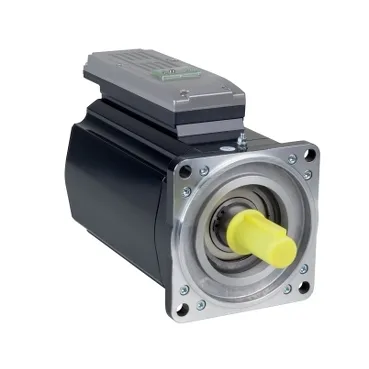
The Schneider Electric ILM1401M31F0000 is a servo motor with integrated drive from the PacDrive 3 range, listed under the ILM device short name as a single-axis integrated servo. Its 8.3 N·m nominal torque and 27 N·m peak stall torque define the working envelope — the figure that decides whether the motor can hold a load through a worst-case acceleration without leaving the drive in current limit. Continuous output is rated at 1300 W with a 3.15 A line-rated current and a 14.6 A Irms ceiling — the Irms figure governs dynamic peak acceleration, while the 3.2 A continuous stall current is the thermal floor under zero-speed hold. Sizing the drive match against the 2.65 N·m/A torque constant keeps the demanded Iq within the controller's current-loop bandwidth.
Feedback, brake, and electrical signature
Position feedback is an absolute single-turn SinCos Hiperface encoder — sufficient for cyclic absolute positioning without a battery-backed multi-turn module, and matched to PacDrive 3 controllers that natively resolve the SinCos protocol. The integrated holding brake delivers 18 N·m of holding torque, sized for vertical-axis static holding rather than dynamic stopping duty. Back-EMF constant of 175 V/krpm at 20 °C sets the field-weakening ceiling; at the 1500 rpm nominal speed the induced EMF sits well below typical 400 V or 480 V DC-bus rails, so the drive runs in the constant-torque region across the rated speed band. Stator resistance of 4.58 Ω phase-to-phase and inductance of 50 mH phase-to-phase at 20 °C define the electrical time constant the controller compensates.
Flange, shaft, and the IP65 envelope
The motor carries an international standard flange at the 140 mm frame size with a 130 mm centring collar, keyed 24 mm shaft at 50 mm length, and four 11 mm mounting holes on the standard bolt circle — a drop-in for the common IEC flange footprint. IP65 sealing on the housing allows washdown-area or panel-side cabinet mounting where occasional fluid contact is expected, with natural convection cooling eliminating the fan-failure mode. Maximum radial force is 2210 N at 1000 rpm, derating to 1760 N at 2000 rpm — the rating that drives pulley and pinion placement relative to the shaft shoulder to keep belt tension within the bearing load envelope. Axial load is constrained to 0.2 × Fr.