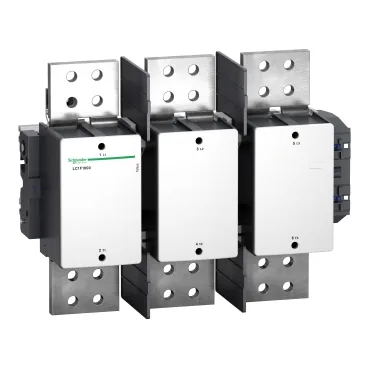
The Schneider Electric LC1F1000Q7 is a TeSys F 3-pole contactor rated for 1000 A in AC-3 duty at ≤440 V AC, 50/60 Hz, with a 380 V AC control coil. The 1250 A AC-1 thermal current (Ith) covers the resistive heating case, so it's also usable for high-current resistive banks or furnace loads. The 380 V AC coil pulls in across 40-400 Hz. Closing time runs 40-80 ms; opening takes 100-200 ms. That's a standard opening delay for a contactor this size — the arc chutes need that window to clear the ionized path on a 1000 A break. Rated breaking capacity is 8 kA per IEC 60947-4-1, backed by a short-time withstand (Icw) of 10 kA for 10 seconds at 40 °C.
If you need a drop-in replacement from current production, a parametric cross-reference to a similar TeSys F frame size is possible — but the coil voltage (380 V AC) and the 1000 A AC-3 rating narrow the field. We can help identify a substitute during the RFQ process.
Plate-mounted — no DIN rail clip on this frame size. The footprint is 438 mm wide by 332 mm high by 238.6 mm deep. That's a large contactor; plan for a backplate or sub-panel with enough clearance for the arc chute ventilation and the power bus bars. Power circuit connections are via bar (3 or 4 cables). Control circuit terminals are screw clamp, accepting 1 to 4 mm² flexible or solid. IP20 on the front face with shrouds fitted — that's touch-safe but not washdown-rated. Install inside a cabinet rated for the environment. Permissible ambient around the device extends to -40 to 60 °C, but the -5 to 40 °C operating window is the one that governs switching duty. Above 40 °C, derate per the thermal curve.
Designed and tested to EN 60947-1, EN 60947-4-1, IEC 60947-4-1, and IEC 60947-1. Rated insulation voltage (Ui) is 1000 V per IEC 60947-4-1, with an impulse withstand (Uimp) of 8 kV. Overvoltage category III — suitable for fixed-installation distribution boards and industrial panels. Protective treatment TH indicates tropicalized protection against heat and humidity.
Selection and sizing notes
That translates to roughly 560 kW at 380-400 V three-phase, or 670 kW at 440 V. The AC-1 rating (1250 A) is higher because resistive loads have no inrush — the contactor's thermal capacity is the limit, not the arc interruption. Associated fuse rating is 1400 A gG at ≤440 V for short-circuit protection. Maximum operating rate is 600 cycles per hour at 55 °C. Power dissipation per pole is 200 W in AC-1 duty. At 1250 A, that's about 0.16 mΩ per pole — consistent with the 0.1 mOhm average impedance at 1250 A, 50 Hz. For panel thermal calculations, budget 600 W total dissipation across all three poles under full AC-1 load.