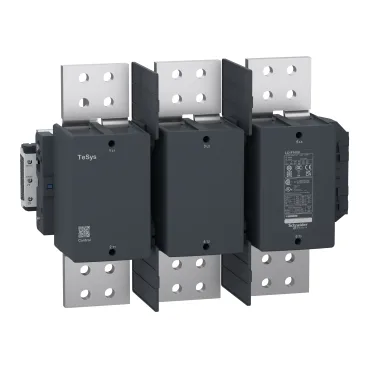
The LC1F1000U7: This is a 3-pole TeSys F contactor rated for direct on-line motor starting (AC-3) and resistive load switching (AC-1). For motor duty, the rated operational current (Ie) is 1000 A in AC-3 at ≤440 V — that is the number that governs the motor branch circuit, not the 1250 A figure. On a 400 V three-phase supply, it handles motors up to 560 kW; at 415 V, 630 kW. The 240 VAC coil draws from a standard control transformer; the control circuit accepts 40 to 400 Hz, so it works on 50 or 60 Hz systems without a coil swap. The rated breaking capacity is 8 kA per IEC 60947-4-1, and the rated short-time withstand current (Icw) is 10 kA for 10 seconds at 40 °C. That means the contactor can hold through a fault long enough for an upstream fuse or breaker to clear — the associated fuse recommendation is 1400 A gG at ≤440 V. The rated insulation voltage (Ui) is 1000 V per IEC 60947-4-1, with an impulse withstand (Uimp) of 8 kV, placing it in overvoltage category III for fixed industrial installations. Mechanically, the contactor closes in 40 to 80 ms and opens in 100 to 200 ms. The maximum operating rate is 600 cycles per hour at 55 °C. The average impedance per pole is 0.1 mΩ at 1250 A, 50 Hz.
Mounts to a plate — no DIN rail on this frame size. The footprint is 438 mm wide by 332 mm tall by 238.6 mm deep. Power connections use bar-type terminals accepting up to 4 cables; control wiring lands on screw clamp terminals accepting 1 to 4 mm² flexible or solid. The front face carries IP20 protection with shrouds fitted (per IEC 60529 and VDE 0106), so it is touch-safe in an enclosed panel but not washdown-rated.
Rated for operation from -5 °C to 40 °C ambient, with storage from -60 °C to 80 °C. Permissible ambient around the device extends to -40 °C to 60 °C, but the operating current ratings assume the tighter -5 to 40 °C window. It operates without derating up to 3000 m altitude. Protective treatment is TH (tropicalized, heat-resistant). Standards compliance includes IEC 60947-1, IEC 60947-4-1, and EN 60947-4-1.