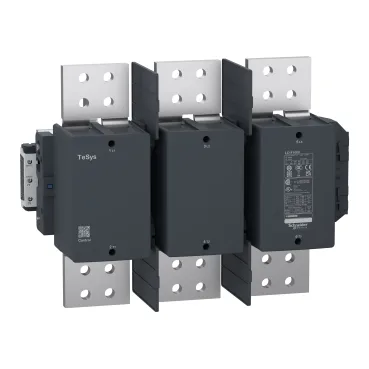
The LC1F1000V7: The headline rating is 1250 A rated operational current (Ie) in AC-3 duty at ≤ 440 V AC, 50/60 Hz. AC-3 is the standard category for squirrel-cage motor starting — switching loads during running, not just at standstill. That 1250 A figure governs the motor it can handle: up to 560 kW at 380–400 V three-phase, or 670 kW at 440 V. The conventional free-air thermal current (Ith) is also 1250 A at 40 °C, so the contactor is thermally sized for continuous resistive loads (AC-1) at the same current. The short-time withstand current (Icw) is 10 kA for 10 seconds at 40 °C, which covers coordination with upstream protective devices during a fault-clearing delay. The coil is 400 V AC, 40–400 Hz — a standard industrial control voltage in many regions. Operating time is 40–80 ms closing, 100–200 ms opening; that matters for sequencing in starter cabinets where multiple contactors must not overlap.
Where It Goes — Deployment Context
This is a plate-mount contactor (not DIN-rail), sized for large motor control centers or dedicated panel builds. The dimensions — 438 mm wide, 332 mm high, 238.6 mm deep — mean it needs a substantial backplate and gland-plate planning. Rated insulation voltage (Ui) is 1000 V per IEC 60947-4-1, with an impulse withstand voltage (Uimp) of 8 kV — suitable for 400 V class systems with overvoltage category III environments.
The LC1F1000V7 is designed and certified to EN 60947-1, EN 60947-4-1, IEC 60947-1, and IEC 60947-4-1. These are the core standards for low-voltage switchgear and contactors for motor starting. The protective treatment is TH (tropicalized) for humidity resistance. Associated fuse rating is 1400 A gG at ≤ 440 V for short-circuit coordination.